Cottage food laws · Vermont
Selling homemade food in Vermont.
Vermont rebuilt its homemade-food law in 2025, and the headline is a good one for a home baker: making shelf-stable goods — cookies, breads, jams, granola, candy, even pH-tested home-canned pickles — is license-free and fee-free up to $30,000 a year. The catch worth knowing up front: “free” isn’t “do nothing.” Even on the free tier, Vermont asks two things of you every single year — a short online training and an annual filing with the Health Department — plus a specific sentence on every label. It’s free of cost, not free of obligations. Here’s the whole picture, in plain English.
Verified against 18 V.S.A. chapter 85, the Vermont Manufactured Food Rule (effective Jan 15, 2026) and the Vermont Department of Health
Last checked June 13, 2026 — every section links its sources.
A plain-English breakdown, not legal advice — we’re not lawyers. Always confirm the details with your own city and state before you sell.
The 2-minute version
Starting path: Cottage Food Operator — other paths differ (see below)
- Sales cap
- $30,000/yr
- State registration
- Required
- Kitchen inspection
- Not required
- Food-handler card
- Required
- Sell at markets
- Yes
- Shipping
- Not allowed
Three cards, the whole story. Everything below is detail — with the actual laws linked, so you never have to take our word for it.
Selling shelf-stable goods?
That’s a cottage food operator — license-free and fee-free up to $30,000 a year for shelf-stable goods made in your own home kitchen. Put the right label on cookies, breads, jams, candy, or granola and sell straight to your neighbors. A separate $10,000 tier for non-bakery processed foods can stack on top.
The free tier’s yearly homework
This is the part most guides skip: even on the free tier, Vermont asks you to do two things every year — complete an online food-safety training and submit an exemption filing with the Health Department. Free of cost, not free of obligations.
Kids’ stands?
Vermont has no lemonade-stand or under-18 exemption — but the cottage path has no minimum age either, so a young person uses the same free path an adult does: shelf-stable goods, the yearly training and filing, the right label.
Two free tiers and three licenses — pick your path
In shortIt splits on one question first: is what you make shelf-stable, and do you stay under $30,000 a year? If yes, you’re a free cottage food operator (with yearly training + filing). A separate $10,000 non-bakery tier stacks on top. Cross the lines — refrigerated foods, selling to restaurants, or passing $30k — and you move to a paid license.
Vermont’s system is one licensing law (18 V.S.A. chapter 85) with license exemptions carved out for small home producers, plus paid licenses for anyone who outgrows an exemption. For a porch shop it splits on one question first: is what you make shelf-stable, and do you stay under $30,000 a year? The cleanest way to see the line: a cheesecake can’t come out of the free cottage path — it needs refrigeration, which makes it a “time/temperature control for safety” food the exemption excludes (same with quiche and cheese danish). Those need a license, not the exemption.
Cottage Food Operator
For shelf-stable food made in your own home kitchen (or a kitchen on your own property), with gross receipts of $30,000 a year or less from cottage foods. No license, no fee.
What “free” still requires: an annual online training, an annual exemption filing with the Health Department, and the right label. (Full list of yearly obligations under “Getting set up.”)
Pick this path if: everything you sell is shelf-stable — cookies, breads, cakes, candy, jams, jellies, granola, trail mix, popcorn, dry tea or coffee, and pH-tested home-canned pickles, vegetables, or fruits — and you’re under $30k a year.
Small Food Processor exemption
A separate free exemption for a non-bakery processed food with gross annual sales under $10,000. Same yearly obligations as Path A — training, filing, and label.
The useful part: Vermont lets you stack the two — up to $30,000 of cottage foods plus up to $10,000 of other processed foods, both license-free.
Pick this path if: you also make a non-bakery processed food and want a second free tier — Vermont lets you stack up to $30k of cottage foods plus up to $10k of other processed foods, both license-free.
Home Bakery license
A license (not a registration), an application, and an opening inspection — $100 a year. There’s no absolute revenue ceiling on a licensed home bakery.
Bakeries under $30k can simply use the free cottage path instead — the license is for those above it.
Pick this path if: you’re a home baker who has outgrown the $30k cottage tier, or who wants to sell beyond the exemption’s lines.
Home Caterer license
This is not cottage food. Prepared meals or food cooked later at an event sold direct to customers is a home caterer — a license, not an exemption, at $155 a year.
You may also need a separate Temporary Food Service License for the event itself.
Pick this path if: you make prepared meals, or food cooked later at an event, sold direct to customers — that’s catering, not cottage food.
Beyond the home tiers, a non-bakery manufacturer above $10,000 pays $175/yr ($10,001–$50,000 gross) or $275/yr (over $50,000), and commercial bakeries run $200–$350/yr — most porch shops never reach these.
Sources: 18 V.S.A. § 4301 (definitions) · 18 V.S.A. § 4353 (fees + thresholds) · 18 V.S.A. § 4358 (exemption + filing) · VDH — Manufactured Food Rule · VDH — Home-Based Food Licenses & Exemptions
Where you can sell
In shortVermont’s free exemptions are written around a dollar cap, not a venue list — so the honest framing is direct-to-neighbor by design, with one explicit channel that’s off-limits: licensed food service establishments (restaurants) may only buy from licensed manufacturers.
Built for direct sales to your neighbors. Vermont’s free exemptions are written around a dollar cap, not a venue whitelist — the law doesn’t publish a list of “allowed places” the way some states do. So the honest framing is: it’s designed for selling your own packaged, labeled cottage foods directly to the people eating them. There’s no statutory venue list naming farmers markets, home pickup, or online, so we don’t quote one.
The one hard “no”: licensed food service establishments. Vermont’s guidance is explicit — “food service establishments, like restaurants, may only purchase food products from licensed food manufacturers.” So an exempt cottage operator may not sell to restaurants or other licensed food-service businesses. To sell to a restaurant, you’d need a license.
Prepared meals are a different door. Selling prepared meals, or food to be cooked later at an event, isn’t cottage food at all — that’s a Home Caterer license (and maybe a Temporary Food Service License for the event).
Selling to retail stores (grocers) is unresolved. Vermont’s primary sources we read don’t address whether an exempt operator may sell to a retail store for resale. We don’t claim it either way — confirm with the Health Department before you build on it.
Out of state / shipping. Vermont doesn’t ban it, but “food products crossing state lines are considered interstate commerce and subject to applicable federal rules and regulations,” and the destination state’s laws may apply too. Once a package leaves Vermont you’re in federal (FDA) territory plus the receiving state’s rules.
Sources: 18 V.S.A. § 4301 · VDH — Food Manufacturing Licensing Exemptions
What you can sell
In shortThe free tier is the shelf-stable rule: a cottage food product is one that “does not require refrigeration or time or temperature control for safety.” The list is illustrative, not closed — and home-canned high-acid goods are in by statute, with a pH/water-activity condition. Cheesecake, quiche, and cheese danish fail.
Cottage food — the shelf-stable rule
A cottage food product is “food sold by a cottage food operator that does not require refrigeration or time or temperature control for safety.” Vermont’s list is illustrative (“such as”), not a closed set.
- Baked goods (non-TCS)
- Candy
- Jams & jellies
- Dry herbs
- Trail mix
- Granola
- Cereal
- Mixed nuts
- Flavored vinegar
- Popcorn
- Coffee beans
- Dry tea
- pH-tested home-canned pickles, veg & fruit
Home-canned pickles, vegetables, or fruits are in by statute — but only at an equilibrium pH of 4.6 or lower OR a water-activity value of 0.85 or less, made from recipes approved by the National Center for Home Food Preservation or reviewed by a food-processing authority. If you’re unsure whether a product fits the shelf-stable definition, you can ask the Health Department for a determination using its Cottage Food Product Review Request Form — though you don’t have to.
Not cottage food (need a license)
- Cheesecake
- Quiche
- Cheese danish
- Anything refrigerated (TCS)
- Dehydrated meats
- Dehydrated fruits & vegetables
- Made in a rented kitchen
“Baked goods that need to be kept cold, like quiche, cheese danish, and cheesecake, are not cottage foods and do not qualify for the exemption.” Vermont defines TCS food by the FDA 2022 Food Code (meat, poultry, fish, shellfish, eggs, milk and dairy, cooked plant foods, baked potatoes, mushrooms, raw sprouts, tofu, untreated garlic-in-oil). Also out: dehydrated meats (meat is TCS) and dehydrated fruits and vegetables (dehydration needs specialized equipment to verify a safe water-activity level). And products made in a rented kitchen — even a licensed commercial one — don’t qualify; the exemption is only for food made in your own home kitchen or a kitchen on your own property.
Sources: 18 V.S.A. § 4301 · VDH — Manufactured Food Rule · VDH — Food Manufacturing Licensing Exemptions
The rules that actually matter
In shortThe free tier caps at $30,000/yr (plus a stackable $10,000 non-bakery tier), is shelf-stable only, and can’t sell to restaurants. Past the cap you don’t lose the right to sell — you move to a paid license with no absolute ceiling. And every year, even free, you train and you file.
- Free of cost, not free of obligationsThe single thing most guides miss: even on the $0 tier, Vermont requires an annual online food-safety training and an annual exemption filing with the Health Department — both confirmed in the rule and the statute, not just guidance. Plan the yearly homework into your calendar.
- The free cottage tier caps at $30,000 a yearGross receipts from cottage food products. The free non-bakery processor tier caps at $10,000, and you can run both at once (up to $30k cottage + up to $10k processed).
- Past the cap you don’t lose the right to sellCross $30k and you move to a paid license ($100/yr home bakery, the relevant processor tier, or a caterer license) — there’s no absolute revenue ceiling in the statute for a licensed home bakery.
- Shelf-stable only, home kitchen only, no restaurantsOn the free tier: nothing refrigerated; no meat, dairy, eggs, or other TCS food; made in your own home kitchen (not a rented or shared commercial kitchen); and no selling to restaurants or other licensed food businesses. Town zoning, home-occupation permits, and any tax registration are set locally and separate from this food law — check yours.
Sources: 18 V.S.A. § 4353 (fees + thresholds) · 18 V.S.A. § 4358 (exemption + filing) · VDH — Manufactured Food Rule · VDH — Food Manufacturing Licensing Exemptions
Getting set up
In shortThe free cottage path has no license to buy — but it has yearly homework: confirm your products are shelf-stable, take the annual training, file the annual exemption with the Health Department, and label correctly. A licensed home bakery or home caterer is an application, a fee, and an opening inspection.
Path A / B — free cottage operator or small processor
- Confirm your products are shelf-stableNo TCS food, nothing refrigerated. If you home-can pickles, vegetables, or fruits, use a recipe approved by the National Center for Home Food Preservation or reviewed by a food-processing authority, and meet the pH-4.6 / water-activity-0.85 condition.
- Take the annual trainingThe Health Department’s “License Exempt Food Processors and Cottage Food Operators Online Training” must be completed before you begin manufacturing and again every year. (We don’t state a price — no official page we read names one; it’s widely described as a free online course, but confirm on the Health Department’s page.)
- File the annual exemptionSubmit a license-exemption filing in the Health Department’s online portal, once each year, attesting that you completed the training. The Department’s guidance gives the deadline as before January 15 each year; the rule itself says the filing is due “on or before a date established by the Department,” so treat January 15 as the Department’s current date and confirm it on the portal when you file.
- Label correctly and keep a clean kitchenPut the seven-element exempt label (next section) on every product and meet the rule’s sanitation requirements. There’s no pre-opening inspection, but a public-health inspector may visit to investigate a potential hazard.
No separate state “food-handler card” beyond the online training appears in the law for the free tier. Questions go to the Health Department’s Food & Lodging Program at 802-863-7221 or FoodLodging@vermont.gov.
Path C / D — licensed home bakery or home caterer
- Apply to the Health DepartmentHome bakery $100/yr; home caterer $155/yr.
- Provide what the application asksProduct information, and for licensed establishments an opening inspection and any process-authority review for special processes.
- Pass the opening inspectionThe license is issued by the Department once you pass.
A licensed kitchen IS inspected — so a licensed operator does not use the exempt-tier “not inspected” label string. See the Labels section.
Sources: 18 V.S.A. § 4358 (exemption + filing) · VDH — Manufactured Food Rule · VDH — Food Processing Establishments · VDH licensing portal
Labels
In shortOn the free cottage / processor tier, every product carries the same seven-element label, set by the Manufactured Food Rule § 6.2.1.1 — including the verbatim “not inspected” statement, in at least 10-point type with clear contrast. Vermont keys the name to the OPERATION, not your personal name, with a physical home-kitchen address (no P.O. box).
Exempt cottage / processor label
- The name and address of your operation. Vermont keys this to the operation (“the name and address of the operation”), not your personal name. Use the physical address of your home kitchen — not a P.O. box — so the product can be traced in a recall.
- The name of the food product
- The ingredients, in descending order of predominance by weight
- The net weight or net volume
- Allergen information as required by federal labeling rules
- Federal nutritional labeling — but only if you make a nutrient-content claim, a health claim, or otherwise provide nutritional information
- The verbatim required statement: “Made in a home kitchen not inspected by the Vermont Department of Health.” — printed in at least 10-point type in a color that gives a clear contrast to the background.
One important guard: the seven-element label above — including the “not inspected” statement — is the exempt-tier label. If you hold a license instead (Path C home bakery or Path D home caterer), your kitchen is inspected, so you follow your license’s labeling, not this exempt statement — stamping “not inspected” on a licensed product would be false. The verbatim string here is only for the free cottage / processor tier.
Sources: VDH — Manufactured Food Rule § 6.2.1.1 · VDH — Food Manufacturing Licensing Exemptions
What changed recently
In shortVermont replaced its whole homemade-food regime in 2025. Act 42 (H.401), effective July 1, 2025, retired the old ~$6,500/yr home-bakery exemption and created the $30,000 cottage tier + $10,000 processor tier + the annual training and filing duty. The permanent Manufactured Food Rule took final effect January 15, 2026, superseding the July 2025 Emergency Rule.
- Vermont replaced its whole homemade-food regime — July 1, 2025Act 42 of 2025 (H.401) was signed June 2, 2025 and took effect July 1, 2025. It retired the old home-bakery exemption (capped at about $125 a week, ≈ $6,500/yr) and created today’s framework: a $30,000 license-free cottage tier, a $10,000 non-bakery processor tier, statutory definitions of cottage food operation/operator/product, and the annual training + annual filing duty for exempt operators. If you read an older guide that says Vermont’s home limit is ~$6,500 a year, it’s describing the repealed rule.
- July 2025 — the Emergency RuleThe Health Department adopted a Manufactured Food Emergency Rule to implement Act 42 immediately while the permanent rule was finalized.
- The permanent rule took effect — January 15, 2026The permanent Manufactured Food Rule (final adopted, effective 1/15/2026) is now the governing rule; it carries the label string, the training and filing requirements, and the exemption thresholds cited throughout this page. One maintainer-level wrinkle for anyone double-checking: the live Health Department guidance PDF (dated Nov 2025) still names the older “Emergency Rule,” but its substance — the $30k/$10k thresholds, the verbatim label, the training and filing — is identical to the permanent rule. If the two ever disagree, the statute and rule control.
Sources: Act 42 of 2025 (H.401), as enacted · 18 V.S.A. § 4353 (fees + thresholds) · VDH — Manufactured Food Rule
Common questions
- Can I sell cheesecake from home in Vermont?
- Not on the free cottage tier — cheesecake needs refrigeration, so it’s a TCS food the exemption excludes (along with quiche and cheese danish). Refrigerated baked goods need a license, not the exemption.
- Is the free tier really free?
- The license and fee are $0 up to $30,000 a year — but “free” still comes with yearly homework: an annual online training and an annual exemption filing with the Health Department, plus the required label. It’s free of cost, not free of obligations.
- What’s the deadline for the yearly filing in Vermont?
- The Health Department’s guidance says file in the online portal before January 15 each year. The rule itself phrases it as “a date established by the Department,” so it’s the Department’s current date, not a statutory one — confirm it on the portal when you file.
- How much can I sell in Vermont?
- Up to $30,000 a year of cottage foods license-free, and you can add up to $10,000 of other processed foods under a second free exemption. Past those, you move to a paid license — there’s no hard revenue ceiling on a licensed home bakery.
- Can a restaurant or store buy my cookies in Vermont?
- A restaurant or other licensed food business: no — as an exempt operator you can’t sell to them; they may only buy from licensed manufacturers. Whether you may sell to a retail store for resale isn’t addressed in the sources we read — confirm with the Health Department before you count on it.
- Can I sell pickles or canned goods from home in Vermont?
- Yes, with conditions: home-canned pickles, vegetables, or fruits are allowed as cottage food if they hit an equilibrium pH of 4.6 or lower or a water activity of 0.85 or less, using a recipe approved by the National Center for Home Food Preservation or reviewed by a food-processing authority.
- Can I dehydrate jerky or fruit at home to sell in Vermont?
- No on both: dehydrated meats are TCS (out), and dehydrated fruits and vegetables need specialized equipment to verify a safe water activity, so Vermont keeps them off the cottage list.
- Can I make cottage foods in a rented commercial kitchen in Vermont?
- No — the cottage exemption is only for food made in your own home kitchen or a kitchen on your own property; renting space (even a licensed commercial one) means you need a license.
- Can I run a dinner out of my home in Vermont?
- That’s not cottage food — prepared meals sold direct to customers, or food cooked later at an event, need a Home Caterer license ($155/yr), and possibly a Temporary Food Service License for the event.
- Do I need a food-handler card in Vermont?
- No separate card beyond the Health Department’s annual online training appears in the law for the free tier.
- Can my kid run a stand in Vermont?
- Yes — there’s no minor exemption, but there’s also no minimum age, so a young person uses the same free cottage path an adult does: shelf-stable goods, the yearly training and filing, the right label.
Sources: 18 V.S.A. § 4301 (definitions) · 18 V.S.A. § 4353 (fees + thresholds) · 18 V.S.A. § 4358 (exemption + filing) · VDH — Manufactured Food Rule · VDH — Food Manufacturing Licensing Exemptions
You won’t be doing this alone
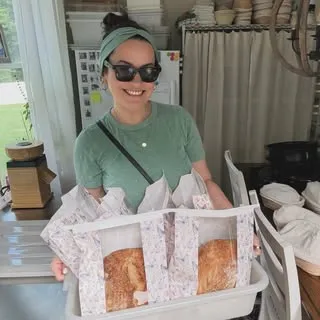
10 porch bakers are already selling across Vermont under these exact laws. Browse their pages and learn from people two steps ahead of you — what they sell, how they price, how they talk about their bread. Cottage bakers are famously generous with what they’ve learned, and most are a DM away on Instagram.
- Adrianna Rhodes 🍞🥖🥐Guilford
- Wild Yeast • EmilySharon
- Bridge Street Breads LLCStowe
- TBTC - The Bread Therapy Co.Burlington
- Cynthia's BakehouseEden
- Sourdough baker in Essex VermontEssex
- Bread from the EarthWest Townshend
- Wild Hearth Sourdough Co. Vermont 🌿Jericho
- Rhonda TallmanSouth Royalton
- Ali’s Kitchen BakeryBurlington
This page is educational, not legal advice — we’re not lawyers, just neighbors who read Vermont’s official sources and wrote down what they say (every claim above links to its source). Vermont rebuilt this law in 2025, so older guides (and even some search results) may describe the repealed ~$6,500-a-year home-bakery rule — this page reflects the current $30,000 cottage framework and the Manufactured Food Rule effective January 15, 2026. The free tier is free of cost but not free of yearly obligations: an annual training and an annual filing. We don’t state a price for the training because no official page we read names one, and the yearly-filing deadline is set by the Department (currently January 15) — confirm both on the Health Department’s portal. Whether an exempt operator may sell to a retail store, and your town’s zoning and tax rules, are separate questions we don’t resolve here. Always double-check the details with your own city and state before you sell. When something here and the law disagree, the law wins; if you spot that happening, tell us and we’ll fix it.