Cottage food laws · Oklahoma
Yes, you can sell what you bake in Oklahoma.
Oklahoma is one of the easiest states in the country to start a porch shop. There’s no license, no registration, no inspection, and no fee — the Homemade Food Freedom Act exempts you the moment you follow its rules. And unlike most states, it doesn’t stop at shelf-stable cookies and jam: with one free food-safety course, you can sell refrigerated foods like cheesecake too, direct to your neighbors. Stay under $75,000 a year and label correctly, and you’re selling. (A rename and a cap raise to $250,000 take effect November 1, 2026 — see “What changed.”) Here’s the whole picture, in plain English.
Verified against the Oklahoma Statutes (Title 2 §§5-4.1–5-4.6) and the Oklahoma Dept. of Agriculture, Food & Forestry
Last checked June 12, 2026 — every section links its sources.
A plain-English breakdown, not legal advice — we’re not lawyers. Always confirm the details with your own city and state before you sell.
The 2-minute version
Starting path: Tier 1 — shelf-stable (non-TCS) food — other paths differ (see below)
- Sales cap
- $75,000/yr
- State registration
- Not required
- Kitchen inspection
- Not required
- Food-handler card
- Not required
- Sell at markets
- Yes
- Shipping
- In-state only
Three cards, the whole story. Everything below is detail — with the actual laws linked, so you never have to take our word for it. (At-a-glance reflects current law; the November 1, 2026 cap raise and rename are flagged where they land.)
Selling shelf-stable goods?
That’s Tier 1 of the Homemade Food Freedom Act — fully exempt, with the widest reach in the country. Put the right label on cookies, breads, cakes, jams, candy, or dry mixes and sell direct, online, shipped within Oklahoma, and through stores. No training, no registration, no fee.
Want to sell cheesecake?
That’s Tier 2 — refrigerated foods. Take one free, online food-safety course (≤8 hours), keep the certificate, and you can make cheesecake, cream pies, and other foods that need to stay cold — but you must sell and deliver them directly to the buyer yourself: no stores, no shipping.
Kids’ stands?
A young baker selling shelf-stable cookies or breads follows the same free, no-license, no-inspection Tier-1 path an adult does — the only requirement is the label. Oklahoma writes no special kid-stand exemption, and doesn’t need to for most stands.
Two tiers, one free law — pick your path
In shortOklahoma has effectively one law — the Homemade Food Freedom Act — and it applies automatically (no program to apply to). What you make decides your tier, on one question: does your food need refrigeration? Shelf-stable → free Tier 1, widest channels. Refrigerated → Tier 2, one free course + direct-to-consumer only.
Oklahoma has effectively one homemade-food law — the Homemade Food Freedom Act. There’s no separate “cottage food program,” no microenterprise permit, and no producer license to apply for: the act is a conditions-based exemption that applies automatically. What you make decides which of its two tiers you’re in, and the split is one question: does your food need refrigeration? The cleanest way to see it — a cheesecake can come straight out of an Oklahoma home kitchen (OSDH names it as a permitted refrigerated food); you just take the free course first and hand it to your neighbor yourself, rather than shipping it or stocking a store shelf. Same product most states ban from home kitchens.
Shelf-stable (non-TCS) food
Anything that’s safe at room temperature (technically, pH ≤ 4.6 or water activity ≤ 0.85). No training, no registration, no fee.
This tier has the widest reach: you can sell direct, online, ship it by parcel within Oklahoma, and place it in retail stores or sell through a third party.
Pick this path if: everything you make is shelf-stable — breads, cookies, cakes, jams, candy, dry mixes, honey.
Refrigerated (TCS) food
Foods that need time- or temperature-control for safety. Before your first sale you complete a free, online, ODAFF-approved food-safety course (≤8 hours) and keep the certificate.
From then on you must sell and deliver the food directly to the consumer yourself — no retail stores, no third-party sale, no parcel shipping.
Pick this path if: you want to sell anything that needs to stay cold — cheesecake, cream pies, cooked vegetables.
Beyond these tiers: if you sell meat, poultry, or seafood, want a third party to resell your refrigerated goods, or pass the sales cap, the act stops covering you — and you’re into licensed-food-establishment territory (ODAFF/OSDH), a real step up most porch shops never need. (Beekeepers have their own separate, even lighter honey exemption — see “What you can sell.”)
Sources: Title 2 §5-4.1 (short title) · Title 2 §5-4.2 (definitions, cap) · Title 2 §5-4.3 (conditions, channels, course) · ODAFF — Food Safety / HFFA
Where you can sell
In shortThe channel depends on the tier. Shelf-stable (Tier 1) is the widest: direct, online, in-state parcel shipping, AND retail/third-party with a placard. Refrigerated (Tier 2) is producer-direct only — no stores, no third party, no shipping.
Tier 1 — shelf-stable goods reach the widest: direct and in person (home, farmers market, events); online and phone orders (“by remote means, including… the Internet or telephone”); delivery and parcel shipping within Oklahoma (by you, a designated agent, “or a third-party carrier, such as a parcel delivery service”); and through retail stores or a third party — a grocery, farm stand, buying club, craft fair, or flea market — “through a producer’s designated agent or a third-party vendor,” with the required placard displayed where your products sit.
Tier 2 — refrigerated goods are producer-direct only. You can take online or phone orders, but the food must be “delivered by the producer directly to the consumer” — no retail stores, no third-party sale, and no third-party delivery or parcel shipping.
Retail resellers carry their own duty. A store or stand that resells your shelf-stable goods almost always needs its own foodservice license — the producer is exempt, the reseller isn’t — and it must display the placard where your products sit.
Out of state: if food is “packaged and distributed in interstate commerce, it shall also be sold and labeled in accordance with federal law.” Federal rules generally make shipping out of a home kitchen impractical; the act doesn’t waive them.
Sources: Title 2 §5-4.3 (channels per tier) · OSDH HFFA Guidance memo (channel matrix, reseller note)
What you can sell
In shortThere’s no positive list — anything is allowed unless excluded. Shelf-stable goods are Tier 1; refrigerated foods (cheesecake, cooked vegetables) are Tier 2 (course + direct-only). Out: alcohol, raw milk, cannabis — and meat, poultry, seafood on both tiers.
Tier 1 — shelf-stable (no positive list)
There’s no positive list in Oklahoma — anything is allowed unless it’s specifically excluded. From OSDH’s guidance, the typical shelf-stable goods:
- Honey
- Jams & jellies
- Breads & cookies
- Cakes
- Spice mixes
- Tea mixes
- Candy & other low-moisture items
“Produce” in the act expressly includes canning, fermenting, and preserving. OSDH lists pies, pickled vegetables, salsas, and other acidified products as possibly non-TCS: “Factors such as what ingredients, the proportions of ingredients, how a vegetable is cut, etc. can drastically alter the safety and quality.” If your recipe lands at pH ≤ 4.6 or water activity ≤ 0.85 it’s Tier 1; if not, it’s Tier 2.
Tier 2 — refrigerated, with the free course
- Cheesecake
- Cooked vegetables
- Cooked noodles
- Cream pies
OSDH names the typical permitted TCS products: “Cheesecake, cooked vegetables, cooked noodles, etc.” Cheesecake test: PASSES. Cheesecake is explicitly listed by OSDH as a permitted refrigerated food under the Act — sold direct-to-consumer after you take the free food-safety course. (Carry both halves — the course and the direct-only channel — never a bare “cheesecake yes.”)
Not allowed (either tier)
- Alcoholic beverages
- Unpasteurized (raw) milk
- Cannabis / marijuana
- Meat & meat by-products
- Poultry
- Seafood
Alcoholic beverages, unpasteurized (raw) milk, and cannabis/marijuana products are prohibited outright; so are seafood, meat (and meat by-products), and poultry products. Those sit outside the Act on both tiers — licensed-establishment territory. Honey has a separate, even lighter exemption: a beekeeper producing fewer than 500 gallons a year from hives wholly within Oklahoma can sell raw, unblended honey and honeycomb under 63 O.S. §1-1331 — direct, online, or through a reseller — with its own label statement (see “Labels”). Honey also qualifies as a shelf-stable food under Tier 1, so most beekeepers can use whichever fits.
Sources: Title 2 §5-4.2 (definitions, prohibited) · Title 2 §5-4.3 (TCS, no meat/poultry/seafood) · OSDH HFFA Guidance memo (cheesecake/TCS list) · HB 1032 (honey exemption, 63 O.S. §1-1331)
The rules that actually matter
In shortCap is $75,000/yr in gross sales today (rising to $250,000 on Nov 1, 2026), complaint-driven. Refrigerated foods are direct-to-consumer only, and need the course first. No meat/poultry/seafood. No license/inspection/fee — but counties can’t block you. Max penalty: a $300 fine.
- $75,000 a year in gross sales — todayCounting “all sales of prepared food produced by the business at any location.” Enforcement is complaint-driven: ODAFF can ask to “verify a producer’s gross sales” only after a consumer complaint — there’s no reporting requirement. This rises to $250,000 on November 1, 2026 (HB 3720) — see “What changed.”
- Refrigerated foods are direct-to-consumer onlyNo retail, no third party, no shipping — and you must complete a food-safety course before selling refrigerated foods, then keep proof; ODAFF can request it on a complaint. (Shelf-stable Tier-1 goods, by contrast, can go through stores and ship in-state.)
- Meat, poultry, and seafood are out — on both tiersSo are alcohol, raw milk, and cannabis products. Everything else is allowed unless it’s excluded.
- No license or fee — counties can’t block you — max penalty $300No license, no inspection, no fee — but ODAFF can act on a complaint, and OSDH keeps authority to investigate a reported foodborne illness. A county ordinance “shall not… impede or restrict the sale of homemade food products in compliance with the law” (local zoning, building codes, and sales-tax registration are separate — see the disclaimer). The maximum penalty for a violation is a fine of up to $300 — no longer a misdemeanor (HB 1032 struck that).
Sources: Title 2 §5-4.2 (cap, prohibited foods) · Title 2 §5-4.3 (channels, TCS course) · Title 2 §5-4.4 (complaint authority) · Title 2 §5-4.5 (penalty ≤ $300) · Title 2 §5-4.6 (county ordinances)
Getting set up
In shortTier 1 is nothing to file — confirm your food is shelf-stable, label it, done. Tier 2 is one free step: take an ODAFF-approved food-safety course before your first sale, keep the certificate, sell direct only. An optional $15/yr registration number can replace your name, phone + address on labels.
Tier 1 — shelf-stable (nothing to file)
- Confirm your food is shelf-stable (pH ≤ 4.6 or water activity ≤ 0.85) and not on the prohibited list
- Label it correctlyCopy the sample below.
That’s it — no application, no inspection, no fee, no course, no registration. (Optional: a $15/yr ODAFF registration number you can put on labels in place of your name, phone, and address — see Labels. Mail the form + $15, no cash, to ODAFF Food Safety Division, P.O. Box 528804, Oklahoma City, OK 73152; division phone (405) 522-6119.)
Tier 2 — refrigerated (one free step)
- Take an ODAFF-approved food-safety course before your first saleFree or low-cost, online, ≤8 hours. ODAFF’s current approved list: the OSU Homemade Food Freedom Act Workshops, ServSafe Food Handler Training, ServSafe Food Manager Training, “Do it Right, Serve it Safe!” Food Employee Permit Training, or any other ANSI-accredited food-handler training.
- Keep your certificateODAFF can ask for proof on a complaint.
- Sell and deliver directly to the consumer yourselfNo retail, no third party, no shipping.
- Label correctlyCopy the sample below.
Sources: Title 2 §5-4.3 (conditions, course, label) · Title 2 §5-4.4 (proof on complaint) · ODAFF — Food Safety (approved-training list) · ODAFF — Producer Registration form ($15)
Labels
In shortEvery product carries the same label, at least 10-point font: producer name + phone, physical address, product description, ingredients, an allergen statement (declare ALL allergens present, not just the six named), and the verbatim “private residence” disclaimer. An optional $15/yr ODAFF registration number can replace your name, phone + address. A third-party retail placard adds “This product may contain allergens.”; honey carries its own statement.
The required label (both tiers)
- Name and phone number of the producer (a business or brand name is optional, not required — the label keys to the individual producer)
- Physical address where the product was produced
- A description of the product (e.g. “Joe’s Salsa”)
- Ingredients, in descending order of proportion
- An allergen statement. The statute says “including” and names only six (milk, eggs, peanuts, tree nuts, soy, wheat) as examples — so declare EVERY allergen your food actually contains (e.g. fish or shellfish), not just those six
- The verbatim required statement, in at least 10-point type: “This product was produced in a private residence that is exempt from government licensing and inspection.”
The $15 registration swap. If you’d rather not print your home address, the optional $15/yr ODAFF registration number replaces your name, phone, and physical address on the label — you still must list ingredients, allergens, and the legal statement. (ODAFF’s form notes your contact info “could still be obtained through an open records request.”)
Third-party retail placard (where a store or stand displays your shelf-stable goods) — a slightly longer verbatim string, with an added allergen sentence: “This product was produced in a private residence that is exempt from government licensing and inspection. This product may contain allergens.”
Honey (the beekeeper exemption) carries its own label set — common food name, net weight, the beekeeper’s name, a current 10-digit phone number, the production address, and the verbatim statement “Bottled or packaged in a facility not inspected by the Oklahoma Department of Health.” (10-point type or larger, in a contrasting color.)
Changing November 1, 2026: both the producer-label and placard disclaimers change “private residence” → “private facility.” Until then, use the “private residence” wording above — printing “private facility” today is non-compliant. (See “What changed.”)
Sources: Title 2 §5-4.3 (label elements, verbatim statement, $15 registration) · OSDH HFFA Guidance memo (placard string) · ODAFF — Producer Registration form · HB 1032 (honey label statement)
What changed recently
In shortStarting November 1, 2026, the cap rises to $250,000 and the act is renamed the Local Food Freedom Act (HB 3720) — signed but NOT yet in effect. 2024 (HB 2975) added the optional $15/yr registration. 2021 (HB 1032) rewrote the law into the Homemade Food Freedom Act — $75k cap, the refrigerated tier, the “private residence” disclaimer.
- Effective November 1, 2026 — the cap rises to $250,000 and the act is renamedHB 3720 (2026 Laws c. 182), signed by the Governor May 5, 2026, takes effect November 1, 2026. It (a) renames the Homemade Food Freedom Act → the Local Food Freedom Act(and “homemade food product” → “local food product”); (b) raises the gross-sales cap $75,000 → $250,000; (c) lets a “local food establishment” operate “at any location, including on the premises of a residence but excluding restaurants” — production is no longer residence-only; (d) changes both disclaimer strings “private residence” → “private facility”; (e) extends the food-safety-training duty from “the producer” to “any person producing the local food”; and (f) adds a new condition that “the producer complies with all local zoning and building code laws.” The channels, prohibited foods, label elements, $15 registration, and $300 fine are unchanged. As of this page’s date (June 2026) it is not yet in effect — today’s law is the $75,000 “Homemade Food Freedom Act” with the “private residence” disclaimer.
- November 1, 2024 — HB 2975 added the optional $15/yr producer registrationA registration number you can put on labels in place of your name, phone, and physical address.
- November 1, 2021 — HB 1032 rewrote the law into the Homemade Food Freedom ActIt raised the cap from the old $20,000 to $75,000, added the refrigerated-food (TCS) tier with the food-safety-course requirement, set the current “private residence” disclaimer, expanded the honey exemption (63 O.S. §1-1331), and removed the old misdemeanor designation — a violation is now just a fine up to $300.
Sources: HB 3720 (2026 — rename, $250k cap, “private facility,” eff. 11/1/2026) · HB 2975 (2024 — $15 registration) · HB 1032 (2021 — created the HFFA, $75k cap, TCS tier)
Common questions
- Can I sell cheesecake from home in Oklahoma?
- Yes — cheesecake is a refrigerated (TCS) food the Act specifically allows. Take the free, online food-safety course first, then sell it directly to the buyer yourself (no stores, no shipping).
- Do I need a license or permit?
- No. There’s no Oklahoma cottage food license, permit, registration, or fee — the exemption is automatic once you follow the rules. (There’s an optional $15/yr registration just for label privacy — not a permit.)
- Is there a sales limit?
- $75,000 a year in gross sales today — rising to $250,000 on November 1, 2026. ODAFF only checks it if someone files a complaint.
- Do I need a food-handler card?
- Not for shelf-stable goods. For refrigerated (TCS) foods, yes — you complete a free, online, ODAFF-approved course (≤8 hours) before your first sale.
- Can a grocery store carry my cookies?
- Yes — shelf-stable goods can go through a store or third party, with the required placard. (Refrigerated foods can’t — those are direct-to-consumer only.)
- Can I sell online or ship?
- Shelf-stable: yes — online orders and parcel shipping within Oklahoma are allowed. Refrigerated: you can take online or phone orders, but you must deliver it directly yourself — no parcel shipping. Shipping across state lines pulls in federal rules the Act doesn’t waive.
- Can I sell salsa or pickles?
- Often yes — as a shelf-stable (acidified) food if your recipe lands at pH 4.6 or lower; OSDH treats salsas and pickled vegetables as “possibly non-TCS” depending on the recipe. If it isn’t shelf-stable, it’s the refrigerated tier (course + direct-only).
- Can I sell honey?
- Yes — a beekeeper under 500 gallons a year, from Oklahoma hives, has a separate honey exemption with its own label statement; honey also counts as a shelf-stable food under Tier 1.
- Can my county shut me down?
- Not for selling compliant homemade food — a county ordinance can’t “impede or restrict” it. Local zoning, building codes, and sales tax are separate matters (and from November 1, 2026, zoning/building-code compliance becomes an explicit condition of the law).
Sources: Title 2 §5-4.2 (cap, prohibited foods) · Title 2 §5-4.3 (channels, course, label, $15 registration) · HB 3720 (2026 — $250k cap eff. 11/1/2026) · OSDH HFFA Guidance memo (cheesecake/TCS, placard)
You won’t be doing this alone
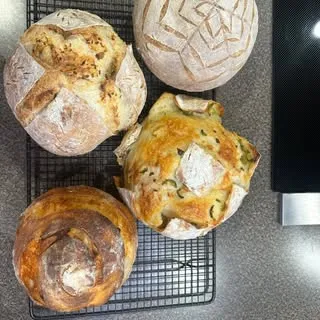
23 porch bakers are already selling across Oklahoma under these exact laws. Browse their pages and learn from people two steps ahead of you — what they sell, how they price, how they talk about their bread. Cottage bakers are famously generous with what they’ve learned, and most are a DM away on Instagram.


This page is educational, not legal advice — we’re not lawyers, just neighbors who read Oklahoma’s official sources and wrote down what they say (every claim above links to its source). Oklahoma’s homemade-food law has two tiers — free shelf-stable goods and refrigerated goods that need a food-safety course and direct-only sales — so make sure you know which one you’re on. A rename (to the Local Food Freedom Act) and a cap raise to $250,000 take effect November 1, 2026; this page describes the law in force now and flags that change as upcoming. Heads-up for anyone checking the statute themselves: the OSCN statute site already displays the November 1 ($250,000) text, so cross-check the effective date. Local zoning, building codes, and sales-tax rules are separate and set locally — check yours. Always double-check the details with your own city and state before you sell. When something here and the law disagree, the law wins; if you spot that happening, tell us and we’ll fix it.