Cottage food laws · Florida
Yes, you can sell what you bake in Florida.
Florida keeps it simple: one law, no license, no registration, no fee — just a label and a short list of rules. If you’re baking bread or making jam in your home kitchen, you can be selling to neighbors as soon as your label’s printed — no state paperwork in between. Here’s the whole picture, in plain English.
Verified against Florida Statutes §500.80 and FDACS’s program page
Last checked June 11, 2026 — every section links its sources.
A plain-English breakdown, not legal advice — we’re not lawyers. Always confirm the details with your own city and state before you sell.
The 2-minute version
- Sales cap
- $250,000/yr
- State registration
- Not required
- Kitchen inspection
- Not required
- Food-handler card
- Not required
- Sell at markets
- Yes
- Shipping
- In-state only
Three cards, the whole story. Everything below is detail — with the actual laws linked, so you never have to take our word for it.
Selling to neighbors?
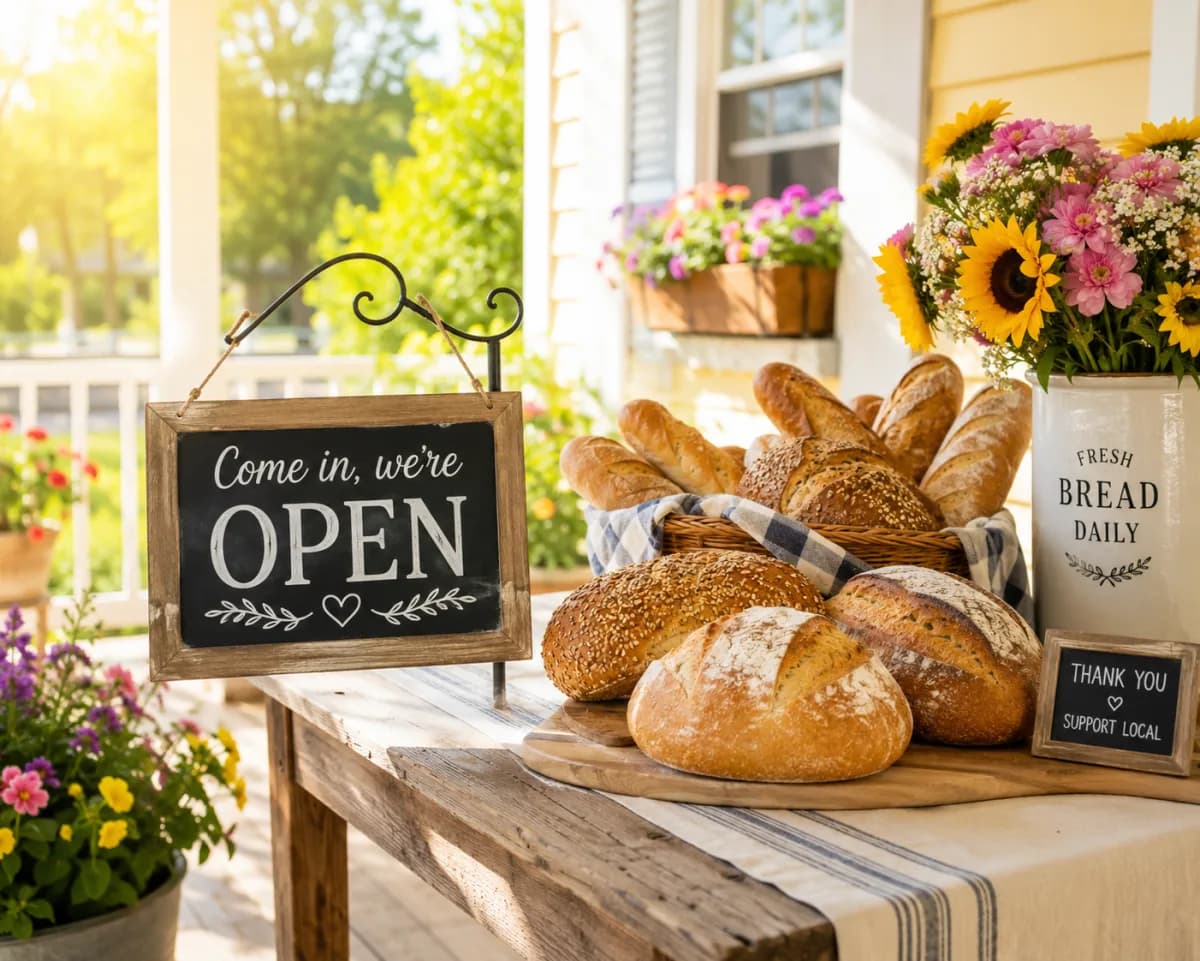
Make shelf-stable foods in your home kitchen, put the required label on every package (one exact sentence the law spells out), and sell direct — porch, markets, roadside stands. No application, no registration, no state agency to notify.
Online orders? Mail?
Florida is one of the states that lets you take orders and payment online — and actually ship, by USPS or commercial carrier, or deliver in person. The hard boundary is wholesale: no restaurants, no grocery shelves, ever.
Kids’ stands?
Florida didn’t write kids into the law — a cookie table runs under the same (light) rules as any porch shop: approved foods, prepackaged, labeled. The state preemption protects a home stand the same way it protects yours.
One way to sell — and it’s the simple one
In shortMost states make you pick between two or three legal paths. Florida has exactly one, and it’s one of the lightest-touch in the country: follow the label, the food list, and the direct-sales boundary, and the law applies to you automatically.
The whole shape of the path
- Make shelf-stable foods (nothing that needs refrigeration to stay safe) in your home kitchen
- Put the required label on every package (below — including one exact sentence the law spells out)
- Sell direct to the person buying — porch, market, online — never wholesale
- Stay under $250,000 a year
Pick this path if: you’re making shelf-stable foods at home and selling them to the people who’ll enjoy them.
The food-permit path
Foods that need refrigeration (cheesecakes, salsas, anything “wet”), stocking grocery shelves, or supplying restaurants all sit past the cottage line — that’s a permitted food establishment under §500.12, with commercial requirements and FDACS inspections. A real step up; many porch shops never need it. Florida has no in-between tier — no registered-cottage wholesale option, no home-kitchen meal permit. (Two narrow farm-side carve-outs exist that aren’t cottage food: limited poultry/egg farm operations, and Florida-boiled-and-bottled cane or sorghum syrup.)
Pick this path if: you want refrigerated foods, grocery shelves, restaurants — or you pass $250,000 a year.
Sources: Fla. Stat. §500.80 · §500.03 (definitions) · §500.12 (food permits) · FDACS cottage foods
Where you can sell
In shortYour porch, markets, roadside stands — and genuinely online, with USPS or commercial-carrier shipping. The hard boundary: never wholesale. Your city can’t ban you, but your HOA still can.
From home and around town: your residence is the home base — FDACS also approves selling at farmers markets, flea markets, and roadside stands, as long as no foods that require a permit share your space. One real-world note: a market’s board can still set its own rules for who sells there — that’s the market’s call, outside the cottage law’s reach.
Online and by mail: Florida is one of the states that lets you take orders and payment over the internet or by mail order. Delivery can happen three ways: you hand it to the person directly, you deliver it to a specific event venue (a wedding cake to the wedding), or you ship it by USPS or a commercial mail carrier. What you can’t do is hand delivery off to a third party — no app-based pickup or distribution; if it isn’t the mail, it’s you.
The hard boundary — never wholesale: no selling to restaurants, no grocery shelves, no consignment, no wholesalers or brokers who’d resell your goods. Every sale runs from you to the person who’s buying it.
Your city can’t ban you. Regulation of cottage food operations is preempted to the state — a local law or ordinance may not prohibit a cottage food operation or regulate how you prepare, store, or sell. The flip side: you must meet Florida’s home-based business conditions — the business stays secondary to the home, street view stays residential, parking stays neighborly, and sales on your property happen at the house itself, not a garage or outbuilding. One thing the law explicitly does NOT override: HOA, condo, and co-op covenants. A deed-restricted community can still say no even though your city can’t.
Sources: Fla. Stat. §500.80(2), (6) · §559.955 (home-based business) · FDACS brochure (PDF)
What you can sell
In shortThe rule behind the list: nothing that needs refrigeration to stay safe. Breads, cookies, jams, candy, honey — yes. Cheesecake, salsa, pumpkin butter — no.
FDACS’s approved list
- Loaf breads, rolls & biscuits
- Cakes, pastries & cookies
- Candies & confections
- Honey (your own, raw)
- Jams, jellies & preserves
- Fruit pies & dried fruits
- Dry herbs, seasonings & mixtures
- Homemade pasta
- Cereals, trail mix & granola
- Coated or uncoated nuts
- Vinegars (incl. flavored)
- Popcorn & popcorn balls
Item-level rulings from FDACS’s own FAQ, the ones sellers ask about most: ✓ nut butters · roasted whole-bean or ground coffee (not drinks) · cake pops (no disallowed fillings or inedible decorations) · caramel and candy apples · fruit butters like apple butter · home-ground flours · dry baking mixes · baked goods with fruit or vegetables baked into the batter · vanilla extract (check with the state’s alcohol division about the alcohol side).
Not cottage food
- Anything needing refrigeration
- Cream-cheese or real-butter icings
- Salsas, sauces & mustard
- Juices
- Vegetable butters & pumpkin/sweet-potato pies
- Jerky, dried meats & meat fillings
- Repackaged bulk honey
- Fresh-fruit garnish
- Pet treats
- Anything with hemp, CBD, or THC
(Shortening or vegan-butter icings are fine; commercially canned ingredients inside baked goods are fine — home-canned aren’t.) If your product isn’t clearly on the safe side of the refrigeration line, ask FDACS before you sell it (FoodSafety@FDACS.gov) — their FAQ rules on specific foods case by case.
Sources: Fla. Stat. §500.03(1)(j) · FDACS cottage foods page · FDACS brochure/FAQ (PDF)
The rules that actually matter
In shortA $250,000 cap (keep simple records — FDACS can ask). Never wholesale. Store it at the house, not the garage. And nobody inspects you on a schedule — the state can knock only if there’s a complaint.
- $250,000 a year in gross salesThat counts all your cottage food sales at any location, no matter how many products or people are involved — no splitting it across family members. FDACS can ask for written documentation of your annual sales, so keep records.
- No wholesale, everDirect sales only — and the cottage law doesn’t exempt you from any state or federal tax law (see the sales-tax question below).
- Store it at home — and home means your homeYou can only sell products stored on the premises — and FDACS reads that as the residence itself (kitchen, spare room, dry basement), not a garage, shed, barn, or outbuilding. FDACS’s position: no rented kitchens, no motor-home kitchens, and nonprofits don’t qualify.
- No routine inspectionsBut if someone files a complaint, FDACS may enter and inspect, and refusing entry is grounds for disciplinary action. The honest frame: nobody inspects you on a schedule; the state can knock if there’s a complaint.
Sources: Fla. Stat. §500.80(1), (4), (5), (7) · FDACS brochure/FAQ (PDF)
Getting set up
In shortThis is where Florida shines: there is no state step. No form, no fee, no registration — the exemption is automatic when you follow the rules. The whole checklist is six errands, and most are reading.
- Check your productsAgainst the approved list and the no-refrigeration rule (above).
- Make your labelNext section — it’s the one mandatory artifact the law requires.
- Check your home frontMeet the home-based business conditions (residential street view, neighborly parking, on-property sales at the house itself, not a garage or outbuilding) — and read your HOA or condo covenants if you have them; the state law doesn’t override those.
- Ask your county or city about a local business tax receiptHome businesses remain subject to local business taxes, and counties and cities may levy one — many do. A quick call to your county tax collector settles it.
- Sort out sales tax if you sell candyMost baked goods and jams are exempt groceries, but candy is taxable — see “Common questions.”
- Keep simple sales recordsEnough to document your annual gross sales if FDACS ever asks.
That’s it. Compare: in most states, step 1 is an application and a fee.
Sources: Fla. Stat. §500.80 · §559.955 · §205.032 (local business tax) · §212.08 (sales tax)
Labels
In shortEvery product is prepackaged with a label: name and address, product name, ingredients, weight, allergens — and one exact sentence, word for word, in at-least-10-point type that contrasts with the background.
Florida cottage food label
- The name and address of your cottage food operation — the physical address of the kitchen where the food is made; a P.O. box doesn’t satisfy it
- The name of the product
- Ingredients, heaviest to lightest — prepared ingredients list their sub-ingredients too (e.g. “soy sauce (wheat, soybeans, salt)”)
- Net weight or net volume
- Allergens per federal rules — the nine major allergens (FALCPA plus the FASTER Act): milk, eggs, wheat, peanuts, soybeans, fish, crustacean shellfish (crab, lobster, shrimp), tree nuts, and sesame (required since January 1, 2023) — in the ingredient list or a “Contains:” statement, naming the specific tree nut
- Nutritional information only if you make a nutritional claim
- The exact sentence in the sample label, word for word, in at least 10-point type, in a color that clearly contrasts with the label background
Two practical carve-outs from FDACS guidance: a cake that can’t physically carry a label gets the full label content on the invoice delivered with it (or on the box, if boxed); and free samples are fine, but they must be prepackaged at home with a labeled package on display.
Sources: Fla. Stat. §500.80(3) · FDA — sesame (FASTER Act) · FDACS brochure/FAQ (PDF)
What changed recently
In shortStable since the 2021 “Home Sweet Home Act” took the cap to $250,000 and opened mail delivery. 2025 modernized a definition’s wording; no 2026 bill touches the law.
- The 2021 expansion is the law you’re readingThe “Home Sweet Home Act” raised the cap from $50,000 to $250,000, opened mail delivery, and locked in the state preemption. Watch for older guides still quoting $50,000 — or the original 2011 rules, when internet sales were banned entirely.
- 2025 — the Farm Bill tidied a definitionA cottage food product is now one “not time or temperature controlled for safety or a potentially hazardous food” — modern food-safety terminology, same meaning. No substantive cottage rule changed; the $250,000 cap and all venues are untouched. (Hemp, for the record, is out — and always has been: an FDACS rule in force since January 1, 2020 bars hemp and hemp-extract foods from the cottage path. And in April 2026, FDACS adopted the 2022 FDA Food Code — the technical source for what counts as “time or temperature controlled for safety.”)
- 2026 session: nothingNo bill in the 2026 legislative session cites §500.80. Stable law is good news for a porch shop.
Sources: Ch. 2021-211 (Home Sweet Home Act) · Ch. 2025-22 (Farm Bill) · FDACS rule 5K-4.034 (hemp)
Common questions
- Do I need a license or permit to sell homemade food in Florida?
- No. There is no Florida cottage food license, permit, registration, or fee — anyone selling you help getting one is selling you something that doesn’t exist. (Your county or city may have a local business tax receipt — that’s a tax receipt, not a food credential.)
- Can I take orders on my website?
- Yes — Florida law explicitly allows selling, offering, and accepting payment over the internet or by mail order. You deliver in person, to the event venue, or by USPS or commercial carrier.
- Can I ship my baked goods to another state?
- The honest answer: Florida’s law doesn’t say. It allows mail delivery without naming a geographic boundary, but once a package crosses the state line you’re in federal (FDA) territory plus the destination state’s own rules — and no Florida source resolves that. Some guides say “ship anywhere”; we won’t repeat that without a source. If out-of-state shipping matters to your porch shop, ask FDACS (FoodSafety@FDACS.gov) before building on it.
- Can I sell cheesecake from home in Florida?
- No — cheesecake needs refrigeration, which puts it outside cottage food. That’s food-permit territory under §500.12.
- Can I sell salsa or barbecue sauce?
- No — FDACS rules “wet” products like salsa, sauces, and mustard out. Vinegars and dry seasoning mixes are the cottage-friendly neighbors of that craving.
- Apple butter or pumpkin butter?
- Apple butter yes — fruit butters are allowed. Pumpkin butter no — vegetable butters aren’t, and pumpkin and sweet potato pies are out too.
- Can a grocery store or restaurant carry my cookies?
- No — that’s wholesale, and Florida’s cottage law has no wholesale option at any price. Direct to the person buying, always.
- Do I charge sales tax on homemade food in Florida?
- Mostly no, sometimes yes. Florida exempts food products for human consumption — baked goods, jams, honey, and bakery products from a seller without eating facilities are exempt groceries. But candy and anything “regarded as candy or confection” is taxable — so a fudge or brittle line means collecting sales tax on those items. If your lineup straddles the line, the Department of Revenue can walk you through registering and which products count.
- Can my city shut down my porch shop?
- Not for being a cottage food operation — regulation is preempted to the state. You do need to meet the home-based business conditions (residential look, neighborly parking, on-property sales at the house itself) — and your HOA’s covenants still apply if you have one.
- Is there a limit on how much I can earn?
- $250,000 a year in gross sales — generous as cottage caps go. Past it, you’re in food-permit territory.
- Does anyone inspect my kitchen?
- Not routinely — no pre-approval, no scheduled visits. FDACS may enter and inspect only if someone files a complaint, and refusing that inspection is grounds for discipline.
You won’t be doing this alone
256 porch bakers are already selling across Florida under these exact laws. Browse their pages and learn from people two steps ahead of you — what they sell, how they price, how they talk about their bread. Cottage bakers are famously generous with what they’ve learned, and most are a DM away on Instagram.
- Mom & Boys MakeryPLANTATION
- The Golden Loaf Home Bakery | Sourdough & SweetsThe Villages
- Divina | Ube & Pandan Baked GoodsOrlando
- Jade- BocasourdoughBoca Raton
- Sourdough BakerySt. Cloud
- Sweet Tea Bakery, FLBradenton
- Pan y Alma by NicolasaMiami
- TruffellasKendall
- Miss Mae's Sweets & Sourdough EST. 2023Ocala
- Dreamy Treats and Sweets, LLCWinter Haven





This page is educational, not legal advice — we’re not lawyers, just neighbors who read Florida’s official sources and wrote down what they say (every claim above links to its source). Counties and cities set their own business-tax-receipt details, and HOA covenants are their own contract — check yours. Always double-check the details with your own city and state before you sell. When something here and the law disagree, the law wins; if you spot that happening, tell us and we’ll fix it.