Cottage food laws · South Carolina
Selling homemade food in South Carolina
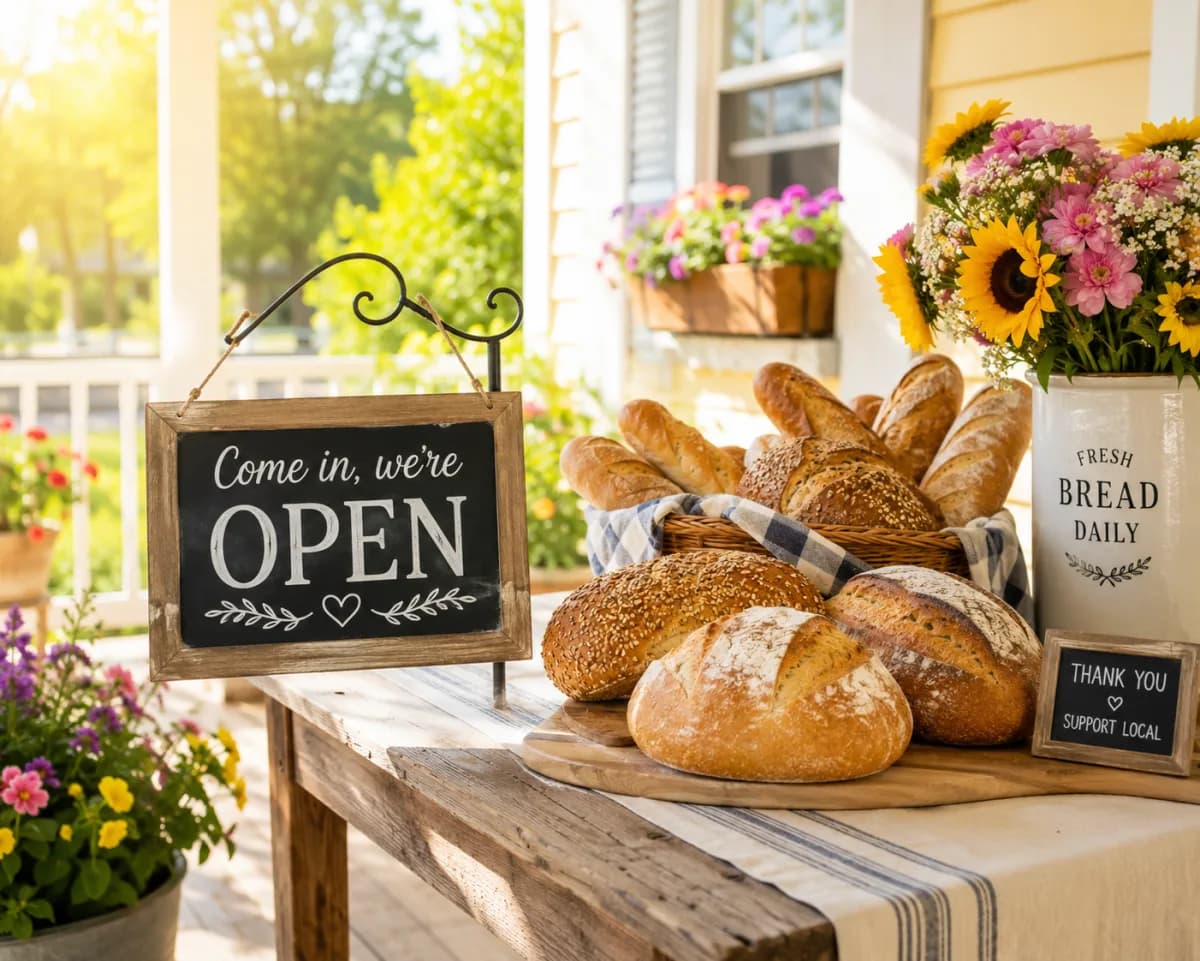
South Carolina is one of the easiest states in the country to start a porch shop. The home-based food law asks for no license, no permit, no registration, no fee, and no sales cap — you make shelf-stable food in your own kitchen, put one required label on it, and you can sell directly to neighbors, online to South Carolina addresses, even to grocery shelves. The one thing to check before you open: a city or county can set its own rule. Here’s the whole picture, in plain English.
Verified against S.C. Code § 44-1-143 and SCDA’s Home-based Food Production Law Guidance
Last checked June 12, 2026 — every section links its sources.
A plain-English breakdown, not legal advice — we’re not lawyers. Always confirm the details with your own city and state before you sell.
The 2-minute version
- Sales cap
- None
- State registration
- Not required
- Kitchen inspection
- Not required
- Food-handler card
- Not required
- Sell at markets
- Yes
- Shipping
- In-state only
Three cards, the whole story. Everything below is detail — with the actual law linked, so you never have to take our word for it.
Selling to neighbors?
Make shelf-stable foods in your home kitchen, put the required label on every package (one exact sentence the law spells out), and sell direct — porch, markets, roadside, events. No application, no registration, no fee, and the home-based path has no inspection.
Online? Grocery shelves?
You can take orders online and ship to South Carolina addresses, and a 2022 change lets you sell to retail stores, including grocery stores. One caveat: SCDA reads the law as in-state sales only, and under-$1,500 sellers must sell in person, direct to the buyer.
A local catch
South Carolina’s law applies “in the absence of a local ordinance to the contrary” — so a city or county can restrict or condition home food sales. It’s the one place this otherwise-open law hands authority back to your town. Check your local rules before you open.
One way to sell in South Carolina — and it’s the simple one
In shortMost states make you pick between two or three legal paths. South Carolina has exactly one that matters for a porch shop — the Home-based Food Production Law — and it’s one of the lightest-touch versions anywhere: no application, no registration, no fee, no inspection, and no sales cap.
The whole shape of the path
- Make non-potentially-hazardous foods (nothing that needs refrigeration to stay safe) in your own home kitchen
- Put the required label on every package (below — including one exact sentence the law spells out)
- Sell directly to the person buying — porch, market, online, by mail — or to retail stores including grocery stores
- Check whether your city or county has an ordinance that changes any of this — the state law steps aside where a local rule says otherwise
Pick this path if: you’re making shelf-stable foods at home and selling them to the people who’ll enjoy them.
The permitted-kitchen path
Foods that need refrigeration (cheesecake, cream pies, anything “wet”), prepared meals, or wholesale across state lines all sit past the cottage line — that’s a Retail Food Establishment permit under SCDA Regulation 61-25, or, for wholesale manufacturing, an SCDA Registration Verification Certificate (RVC). Two things to know: your family-use home kitchen can’t be permitted — you’d need a separate kitchen in the dwelling, a shared-use permitted kitchen, or a commercial facility; and it’s a real step up in cost and inspection that most porch shops never need. (One narrow neighbor: honey — a beekeeper operates either under the cottage law or under an SCDA honey exemption / RVC, not both at once; switching means emailing SCDA to surrender the exemption first.)
Pick this path if: you want refrigerated foods, prepared meals, or to sell wholesale across state lines.
Sources: S.C. Code § 44-1-143 · SCDA Guidance (PDF) · SCDA Reg 61-25 (permitted kitchen)
Where you can sell
In shortYour porch, markets, roadside, events — and online or by mail to South Carolina addresses, plus grocery and retail shelves. The catches: SCDA reads the law as in-state only, under-$1,500 sellers sell in person only, and a city or county ordinance can change the rules.
Direct to the person buying: the law lets you sell “directly to a person, including online and by mail order.” Your porch, farmers markets, roadside stands, and events all fit “directly to a person” — though a market or venue can set its own vendor rules, which is the venue’s call, outside the cottage law’s reach.
Online and by mail — within South Carolina. You can take orders and ship, but SCDA reads the law as covering in-state sales only: its guidance says the cottage law “is only applicable to sales intrastate. You can sell online for delivery to South Carolina addresses. Products that cross state lines are subject to FDA regulations.” Worth being precise: the statute itself doesn’t write a geographic line — subsection (E) just says “online and by mail order.” The in-state limit is SCDA’s stated interpretation. If shipping out of state matters to your porch shop, treat it as unsettled and ask SCDA (homebasedfoods@scda.sc.gov) before you build on it.
Grocery and retail stores — yes. This is a 2022 expansion: you can sell “to retail stores, including grocery stores.” The store carries one duty, not you: it “must post clearly visible signage indicating that home-based food products are not subject to commercial food regulations.”
Restaurants — limited. A packaged, labeled cottage product can be sold by a retail store, but home-based food may not be served or used as an ingredient in a restaurant’s dishes without an SCDA-approved variance — and that’s the restaurant’s responsibility to obtain, with a consumer advisory. Food trucks — pre-packaged only: only product you made and packaged in your home kitchen; no preparing or icing inside the mobile unit.
The under-$1,500 corner. If your operation nets under $1,500 a year, the law doesn’t apply to you at all (see “Limits”) — but SCDA’s guidance says those sellers may not sell at retail locations: the producer “must be physically present and sell directly to the end consumer.” That restriction is SCDA’s guidance, not statutory text.
Your city or county can change the rules. The law applies “in the absence of a local ordinance to the contrary” — meaning a municipality or county can restrict or condition home food sales. Check your local rules (zoning, business licensing, any home-food ordinance) before you open; this is the one place where South Carolina’s otherwise-open law hands authority back to your town.
Sources: S.C. Code § 44-1-143(E), (I) · SCDA Guidance (PDF)
What you can sell
In shortThe rule behind the list: nothing that needs refrigeration or time/temperature control to stay safe. Breads, cakes, cookies, candy, jams, honey — yes. Cheesecake, cream pies, pickles, salsa, bottled drinks — no. Two things excluded by name in the statute: aluminum canned goods and charcuterie boards.
On the safe side of the line
The 2022 expansion dropped the old “candy and baked goods” short list in favor of all non-potentially-hazardous (non-PHF) foods. SCDA’s guidance lists these as illustrative:
- Breads, incl. sourdough & bagels
- Cheese breads (cheese baked in)
- Cakes & cupcakes (shelf-stable icing)
- Cookies, brownies & heat-treated dough
- Candy, chocolate & fudge
- Jams, jellies & preserves (acidic fruits)
- Granola, chips, popcorn & roasted nuts
- Roasted coffee
- Dried herbs, spices, teas, fruits & veg
- Extracts & heat-dried pasta
- High-acid fruit pies
- Honey
Cakes and cupcakes with buttercream or cream-cheese icing are fine if the recipe is shelf-stable; dried fruits and vegetables are fine except melons and tomatoes; fruit jams and curds key on acidic fruits with science-based recipes.
Not cottage food
- Cheesecake (all varieties)
- Anything refrigerated
- Cream, custard, meringue & pumpkin pies
- Fresh-fruit fillings
- Pickles, salsa, hot sauce & relish
- Acidified or fermented foods
- Bottled beverages (juice, kombucha, kefir)
- Ice cream
- Meat, poultry & seafood
- Prepared meals & casseroles
- Sprouts; CBD / Delta-8 / Delta-9
- Pet treats; repackaged bulk foods
Cheesecake fails the test — SCDA is explicit: a food “(such as cheesecake) that is not allowed under the Home-based Food Production Law must be prepared in a commercial kitchen and sold under a retail food establishment permit.” That’s the permitted-kitchen path, not your home kitchen. If your product isn’t clearly on the safe side of the line, ask before you sell it — SCDA and Clemson Extension answer specific-food questions (sccottagefood@clemson.edu).
Sources: S.C. Code § 44-1-143 · SCDA Guidance (PDF)
The rules that actually matter
In shortNo sales cap — the only dollar figure is a $1,500 floor (under it, the law doesn’t apply to you). Your own home kitchen, non-PHF foods only, light sanitation rules — and the one real catch: a local ordinance can override.
- No sales cap§ 44-1-143 sets no annual revenue limit at all — South Carolina is, unusually, an uncapped cottage state. The only dollar figure in the law is a floor, not a ceiling (below).
- The $1,500 floorIf your operation nets less than $1,500 a year, the law’s requirements don’t apply to you — verbatim: “The provisions of this section do not apply to an operation with net earnings of less than fifteen hundred dollars annually but that would otherwise meet the definition of a home-based food operation.” SCDA reads that to mean under-$1,500 sellers can skip even the labeling rules, but must sell in person, direct to the consumer, and not through retail locations.
- Your own home kitchen, non-PHF onlyThe law defines the operation as an individual “operating out of the individual’s dwelling” — a rented or commercial kitchen isn’t the cottage path. Everything must be non-potentially-hazardous, and aluminum canned goods and charcuterie boards are excluded by name. Light sanitation rules still apply: supervise helpers; keep pets and domestic activity out during production; exclude anyone ill; use an approved water supply and sewage disposal; keep a working refrigerator and toilet; store ingredients separately; keep the space pest-free.
- A local ordinance can overrideA city or county rule to the contrary takes precedence — the state law applies only “in the absence” of one. This is South Carolina’s one real catch; check your local zoning and any home-food ordinance before you open.
Sources: S.C. Code § 44-1-143 · SCDA Guidance (PDF)
Getting set up
In shortThis is where South Carolina shines: on the home-based path there is no state step. No form, no fee, no registration, no inspection — the exemption is automatic when you follow the rules.
- Check your productsAgainst the non-PHF rule and SCDA’s allowed / not-allowed lists (above) — when in doubt, it’s the refrigeration line.
- Make your labelNext section — the one mandatory artifact the law requires.
- (Optional) Request a free SCDA ID numberIf you’d rather not print your home address on the label, SCDA will issue you an identification number to use instead. Apply to SCDA Retail Food Safety & Compliance (homebasedfoods@scda.sc.gov; the application is in SCDA’s guidance) — it’s voluntary and there’s no fee.
- Check your city and countyBecause a local ordinance can override the state law, call your municipality / county about any home-food rule, zoning, or local business license before you open. (Business licensing in SC is local and tax-side — SCDA points sellers to the SC Department of Revenue and the SC SBDC, 803-777-0749, for that; it’s separate from the food law.)
- If you use your own chickens’ eggs as an ingredientNote that SCDA requires a separate egg license.
That’s it. Compare: in most states, step 1 is an application and a fee.
Sources: S.C. Code § 44-1-143 · SCDA Retail Food Safety & Compliance · SCDA Guidance (PDF)
Labels
In shortEvery packaged item carries a label: the operation’s name and address, product name, ingredients — and one exact sentence, word for word, in all capital letters, in a color that contrasts with the background. Unlike Florida or Ohio, South Carolina sets no minimum type size.
South Carolina home-based food label
- The name and address of your home-based food production operation — the law keys the label to the operation. If you’d rather not show your home address, SCDA issues an identification number to use in place of the address (not the name), on request and at no charge
- The name of the product
- The ingredients, in descending order of predominance by weight
- This exact sentence, word for word, in all capital letters, in a color that clearly contrasts with the background: “PROCESSED AND PREPARED BY A HOME-BASED FOOD PRODUCTION OPERATION THAT IS NOT SUBJECT TO SOUTH CAROLINA’S FOOD SAFETY REGULATIONS.” — the statute requires all caps and a contrasting color, but, unlike Florida or Ohio, it sets no minimum type size. Make it conspicuous and high-contrast; there’s no point-size floor to hit
- Major-allergen declaration (SCDA labeling guide, from federal rules) — the nine major allergens: wheat, soy, milk, eggs, fin fish, crustacean shellfish, peanuts, tree nuts, and sesame — naming the species for fish and the type for tree nuts
- Net contents in the lower third of the front panel, in both customary and metric units
- A Nutrition Facts panel is not required unless you make a nutrient or health claim — and no health claims are allowed on cottage products
If you use the SCDA identification number, it substitutes for the address only — the operation’s name still appears on the label.
Sources: S.C. Code § 44-1-143(D) · SCDA Retail Food Safety & Compliance · SCDA Guidance (PDF)
What changed recently
In shortThe rules for sellers are stable — the same § 44-1-143 since 2022. What changed is the agency: the home-based food program moved from DHEC to the SC Department of Agriculture on July 1, 2024. The current guidance is SCDA’s July 2025 version.
- July 1, 2024 — the regulator changed2023 Act No. 60 (Senate Bill S.399) restructured the old Department of Health and Environmental Control (DHEC) and moved its retail food program — including the home-based food production / cottage law — to the SC Department of Agriculture (SCDA), effective July 1, 2024. The rules for sellers didn’t change — the same § 44-1-143 applies — but the agency you deal with is now SCDA, not DHEC. Old DHEC contacts, forms, and links are stale; the current regulator is SCDA Retail Food Safety & Compliance (homebasedfoods@scda.sc.gov; 350 Ballard Court, West Columbia, SC 29172).
- July 2025 — current guidance publishedSCDA’s Home-based Food Production Law Guidance (Version 1.4, July 2025) is the current official interpretive document — the source for the allowed / not-allowed lists, the label guide, and the ID-number application.
- May 23, 2022 — the last change to the law itself2022 Act No. 208 (S.506) expanded the cottage law to all non-PHF foods, added online/mail-order and retail-store sales, added the optional ID-number-instead-of-address label option, and raised the exemption floor from $500 to $1,500. The statute’s history line ends there; we found no 2024–2026 bill amending § 44-1-143.
Sources: 2023 Act No. 60 (S.399) · 2022 Act No. 208 (S.506) · SCDA Guidance (PDF) · SC bill search
Common questions
- Do I need a license or permit to sell homemade food in South Carolina?
- No. South Carolina has no home-based food license, permit, registration, application, or fee — SCDA’s own guidance says so: “There are no licenses, permits, or mandatory applications related to producing food under the Home-based Food Production Law.” Anyone selling you a “cottage food license” is selling something that doesn’t exist.
- Is there a limit on how much I can sell?
- No — the law has no sales cap. The only dollar figure is a floor: under $1,500 a year and the law’s requirements don’t apply to you at all.
- Can I sell cheesecake from home?
- No — cheesecake needs refrigeration, which puts it outside the home-based path. SCDA says foods like cheesecake “must be prepared in a commercial kitchen and sold under a retail food establishment permit.”
- Can I sell salsa, pickles, or hot sauce?
- No — acidified and fermented foods are out; they’re not non-potentially-hazardous. High-acid fruit jams and dry seasoning blends are the cottage-friendly neighbors.
- Can I take orders on my website?
- Yes — the law allows selling “online and by mail order.” SCDA reads the cottage law as covering South Carolina deliveries only, though, and treats anything crossing state lines as FDA territory. See the next question.
- Can I ship to my sister in another state?
- Treat it as unsettled. The statute itself names no geographic boundary, but SCDA’s position is that the cottage law “is only applicable to sales intrastate” and that out-of-state shipments fall under FDA rules. We won’t tell you to ship across state lines on the cottage exemption — ask SCDA (homebasedfoods@scda.sc.gov) first.
- Can a grocery store carry my cookies?
- Yes — a 2022 change lets you sell to retail stores, including grocery stores. The store has to post signage that the products aren’t subject to commercial food regulations; that’s the store’s job, not yours.
- Does anyone inspect my kitchen?
- No — the home-based path has no registration and no inspection. (A permitted Retail Food Establishment, the path past cottage, is inspected — but your family-use home kitchen can’t be permitted anyway.)
- Can my city shut down my porch shop?
- Possibly — and this is South Carolina’s one real catch. The state law applies “in the absence of a local ordinance to the contrary,” so a city or county can restrict home food sales. Check your local zoning and any home-food ordinance before you open.
- Do I have to print my home address on the label?
- No — SCDA will issue you a free identification number to use in place of your address, on request. The ID number substitutes for the address, not the operation’s name.
You won’t be doing this alone
47 home bakers and porch shops are already selling across South Carolina under these exact rules. Browse their pages and learn from people two steps ahead of you — what they sell, how they price, how they talk about their bread. Cottage bakers are famously generous with what they’ve learned, and most are a DM away on Instagram.





This page is educational, not legal advice — we’re not lawyers, just neighbors who read South Carolina’s official sources and wrote down what they say (every claim above links to its source). South Carolina’s home-based food law applies only “in the absence of a local ordinance to the contrary” — so a city or county can set its own rule, and you should check yours. The home-based food program moved from DHEC to the SC Department of Agriculture on July 1, 2024; the rules for sellers didn’t change, but SCDA is now the agency you deal with, and older DHEC contacts and forms are out of date. Always double-check the details with your own city and state before you sell. When something here and the law disagree, the law wins; if you spot that happening, tell us and we’ll fix it.