Cottage food laws · North Dakota
Yes, you can sell what you bake in North Dakota.
North Dakota has one of the most permissive homemade-food laws in the country — a true food freedom law — and it’s about as simple as it gets: no license, no permit, no registration, no inspection, no fee, and no sales cap. The state isn’t even allowed to require those things. North Dakota is also unusual in what it lets you make: it is not shelf-stable-only — cheesecake, cream pies, and custard are allowed, as long as you keep and transport them frozen and add a safe-handling note. Since March 2025 you can also take online, phone, and mail orders (poultry is the one exception on shipping out of state). The trade-off for all that freedom is the channel: every sale has to go directly from you to the person who’ll eat it — never onto a store shelf or through a restaurant. Here’s the whole picture, in plain English.
Verified against North Dakota’s cottage food chapter (NDCC ch. 23-09.5), as amended by SB 2386 of 2025 and ND Health & Human Services cottage food page
Last checked June 13, 2026 — every section links its sources.
A plain-English breakdown, not legal advice — we’re not lawyers. Always confirm the details with your own city and state before you sell.
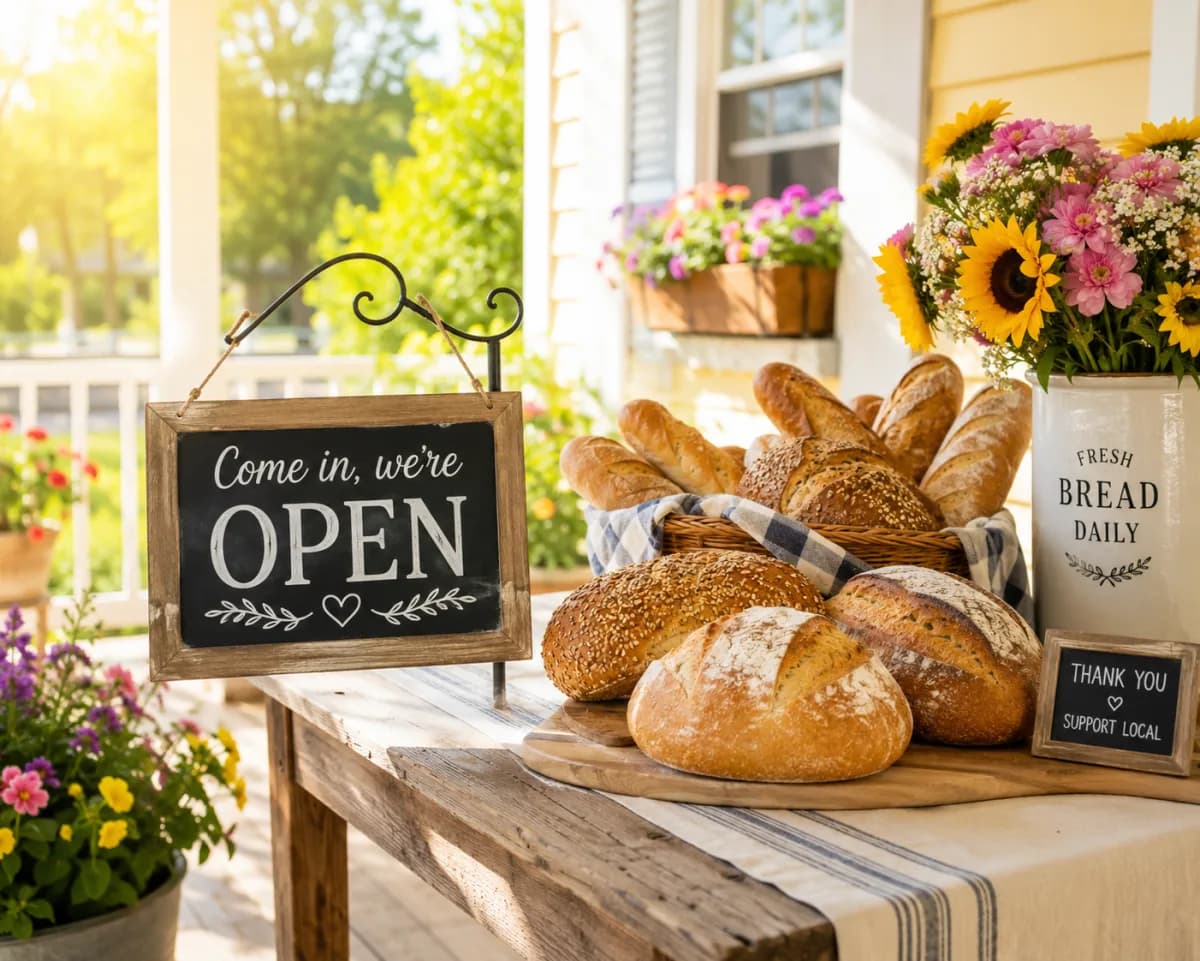
The 2-minute version
- Sales cap
- None
- State registration
- Not required
- Kitchen inspection
- Not required
- Food-handler card
- Not required
- Sell at markets
- Yes
- Shipping
- In-state only
Three cards, the whole story — including the one thing North Dakota does ask of you. Everything below is detail, with the actual law linked, so you never have to take our word for it.
Selling to neighbors?
Make food in your home kitchen and sell direct — porch, markets, by phone, online. No application, no registration, no fee, no agency to notify, no cap on what you earn. And unlike most states, refrigerated baked goods like cheesecake are in, as long as you keep them frozen and add a safe-handling note.
Required label / sign
North Dakota asks for just one thing: a short advisory — the “made in a home kitchen, not inspected” line — as a sign at your point of sale or a label on the product (your choice). The state does not make you print your name, address, or ingredients — and it bars agencies from adding those.
Kids’ stands?
North Dakota didn’t write kids into the law — a cookie table runs under the same free, no-license, no-cap path any porch shop does. And because no name or address goes on the label, a kid’s stand doesn’t have to post a child’s name to be compliant — just the advisory sign.
One way to sell — and it’s a generous one
In shortMost states make you choose between two or three legal paths. North Dakota has essentially one for home cooks — the cottage food chapter, NDCC ch. 23-09.5 — and it’s one of the lightest-touch in the country: sell direct, inform the buyer, post the advisory, and the law applies to you automatically.
The whole shape of the path
- Make food or drink in a kitchen “designed and intended for use by the residents of a private home” — that’s the statute’s definition of a cottage food operator
- Sell directly to the informed end consumer — the last buyer, who’s been told it isn’t licensed or inspected — and only for home consumption
- Post the required consumer advisory — a sign at the point of sale or a label on the product (below) — and inform the buyer it isn’t inspected
- For refrigerated baked goods (cheesecake, cream, custard), add safe-handling instructions and a frozen-transport disclosure
- There’s no cap — sell as much as you can make
Pick this path if: you’re making food at home and selling it directly to the people who’ll enjoy it.
The licensed-establishment path
North Dakota’s hard line is the channel: your goods can’t go onto a store shelf or through a restaurant. If you want that, you leave the cottage exemption and apply for a licensed food establishment under NDCC ch. 23-09 (annual fees in NDAC 33-33-08-01 run roughly $130–$310 depending on the operation, plus a $100 initial license-application fee), with plan review and inspections. A real step up; most porch shops never need it.
Pick this path if: you want to wholesale to stores or sell through restaurants.
Sources: NDCC ch. 23-09.5 · SB 2386 (2025) enrolled act · ND HHS Cottage Food page · NDAC 33-33-08-01 (licensed-path fees)
Where you can sell
In shortBroad on channels, strict on who buys. Your porch, a farm, a farm stand, farmers markets, by delivery — and, since March 2025, by phone, online, and mail. Every sale runs to the informed end consumer, for home consumption. Never to a store or a restaurant. Your city and county can’t require a cottage-food permit.
In person and around town: the statute lists “a farm, ranch, farmers market, farm stand, home-based kitchen, or any other venue not otherwise prohibited by law” — your porch is the home base — and transactions may also occur by delivery.
By phone and online — new since March 2025: SB 2386 struck the old ban on transactions “conducted over the internet or phone, through the mail, or by consignment.” Internet, phone, and mail orders are now legal. (If a guide tells you North Dakota bans online cottage sales, it’s quoting the pre-2025 law — see “What changed.”)
Out of state — read this carefully. SB 2386 also struck the blanket “involve interstate commerce” ban, so state law no longer prohibits shipping your non-poultry goods across state lines. But two things this North Dakota page can’t resolve for you still apply: federal food law (FDA registration and labeling for interstate shipments) and the destination state’s own cottage law. Treat in-state shipping as clearly fine and out-of-state shipping as a check-with-FDA-and-the-other-state question before you mail across a border. Poultry is the exception even under state law — a cottage poultry sale still may not involve interstate commerce.
The hard boundaries: never to a reseller or a food business — “except for whole, unprocessed fruits and vegetables, food prepared by a cottage food operator may not be sold or used in any food establishment, food processing plant, or food store.” No grocery shelf, no restaurant, no wholesale-for-resale. And sales must be only for home consumption — food consumed within a private home (whether a catered event or office sits inside that line isn’t interpreted anywhere we found).
Your city and county can’t license you for it. The chapter bars “a state agency or political subdivision” from requiring “licensure, permitting, certification, inspection, packaging, or labeling” for cottage food sales. A North Dakota city or county can’t make you get a cottage-food license or permit. (Generic zoning / home-occupation rules about where you operate are a separate question the chapter doesn’t address — check your city. General state tax law still applies — see “Getting set up.”)
Sources: NDCC ch. 23-09.5 (§ 23-09.5-02) · SB 2386 (2025) enrolled act
What you can sell
In shortNorth Dakota defines cottage food openly, not by an approved list — and it is NOT shelf-stable-only. Breads, cakes, jams, home-canned goods, even cheesecake and cream pies (kept frozen). The prohibitions are short: no uninspected meat, and own-raised poultry only, capped at 1,000 birds.
Allowed — and broader than most states
A “cottage food product” is “baked goods, jams, jellies, and other food and drink products” — an open definition, not an approved list. There’s no shelf-stable / non-TCS restriction in current law — the pH and “low-risk only” limits in older guides lived in a rule (NDAC 33-33-10-02) that was repealed effective October 1, 2021.
- Breads, cakes, cookies, pastries & pies
- Jams, jellies & preserves
- Cheesecake (frozen, with a safe-handling label)
- Cream, custard & meringue baked goods
- Pumpkin pie & cream-cheese baked goods
- Home-canned goods, pickles & fermented foods
- Beverages & other “food and drink products”
- Eggs from your own flock (a separate egg law)
The unusual yes — refrigerated baked goods. The statute names “cream, custard, meringue, cheesecake, pumpkin pie, and cream cheese” baked goods as allowed, provided they carry safe-handling instructions and a frozen-transport disclosure (see the cheesecake question below). Whether “transported and maintained frozen” is a literal handling duty or only a labeling duty is genuinely ambiguous and no agency guidance interprets it — so the safe read is to actually keep these products frozen and add the note. Low-acid home canning carries a real botulism risk; the law doesn’t ban it, but use a tested process.
Not from a home kitchen — or capped
- Uninspected products made from meat
- Anything sold to or through a store
- Anything sold to or through a restaurant
- Own-raised poultry over 1,000 birds/year
- Poultry shipped across state lines
- Raw (unpasteurized) milk — a separate law
Uninspected meat products are barred outright. Poultry is allowed only if you slaughter no more than 1,000 birds you raised yourself per year, don’t buy or sell anyone else’s poultry, keep the product unadulterated and properly described, and don’t cross state lines. The store/restaurant line is a channel rule, not a food rule (above). Raw milk runs through a separate farm-sales regime (NDCC 4.1-25-40.1, in-state only) — if you’re selling raw dairy, read that law, not this page. If your product isn’t clearly inside the chapter, the statute lets you ask the department for “assistance, consultation, or inspection, upon request” before you sell it.
Sources: NDCC ch. 23-09.5 (§§ 23-09.5-01, -02) · NDAC ch. 33-33-10 (repealed product rules)
The rules that actually matter
In shortNo sales cap, $0 to the state, no food-handler card, no scheduled inspection. The one mandatory duty is the consumer advisory (one line, sign or label). Refrigerated goods carry a frozen-transport duty. The single hard line is direct-to-consumer only — and taxes still apply.
- No sales cap — noneWe read the full chapter (both sections); there is no annual revenue, income, or volume limit anywhere in NDCC 23-09.5. The only number in the chapter is the 1,000-bird ceiling on own-raised poultry. (If a guide quotes a dollar cap for North Dakota, it’s wrong — the chapter has never had one.)
- $0 to the state — and no food-handler cardNo registration, permit, license, certification, inspection, or fee — the statute forbids the state and local governments from requiring them. Nothing in the chapter requires food-safety training, a food-handler permit, or any certification either.
- One required line — the consumer advisoryThe lone mandatory artifact: the “made in a home kitchen, not inspected” advisory, posted as a sign at the point of sale or as a label on the product (your choice). Separately, you must inform every buyer the food isn’t certified, licensed, regulated, or inspected. (See the next section for the exact wording.)
- Refrigerated foods carry a frozen-transport dutyCream / custard / cheesecake-type baked goods must be labeled “with safe handling instructions and a product disclosure statement indicating the product was transported and maintained frozen.” The statute prescribes no exact wording for this one — write it plainly and truthfully, and keep these products frozen.
- Direct-to-consumer only — and taxes still applyThe single most important channel line on this page: no stores, no restaurants — every sale runs from you straight to the eater (whole uncut produce is the only thing you may sell into a food business). And cottage status doesn’t exempt you from sales tax — baked goods generally aren’t taxable “unless sold with eating utensils or in a heated state,” but prepared food, candy, and soda are; confirm your product mix with the Office of State Tax Commissioner.
Sources: NDCC ch. 23-09.5 (§ 23-09.5-02) · ND Office of State Tax Commissioner — Special Events guideline
Getting set up
In shortThis is where North Dakota shines: there is no state food step. No form, no fee, no registration, no inspection — the exemption applies automatically when you sell direct and post the advisory. The whole checklist is reading, a sign, and (for refrigerated goods) a note.
- Confirm you’re selling direct to the eaterNot to a store, processing plant, or restaurant — whole uncut fruits and vegetables are the only thing you may sell into a food business.
- Post the consumer advisoryA sign at your point of sale or a label on the product, carrying the statute’s exact statement (next section).
- Tell every buyer it isn’t inspectedThe law makes informing the buyer its own duty: you “shall inform the end consumer that any cottage food product … is not certified, labeled, licensed, packaged, regulated, or inspected.”
- If you make refrigerated baked goods, add the frozen-transport noteSafe-handling instructions plus a “transported and maintained frozen” product disclosure — and keep/transport them frozen.
- If you sell own-raised poultry, mind the limitsStay under 1,000 birds/year, don’t resell others’ poultry, and keep it in-state.
- Mind the general tax pieceCottage status doesn’t waive tax law — check whether your product mix needs a sales-and-use-tax permit with the Office of State Tax Commissioner. (A generic local business license or zoning question is separate from the food chapter — check your city.)
That’s it. Compare: in most states, step one is an application and a fee.
Sources: NDCC ch. 23-09.5 (§ 23-09.5-02) · ND HHS Cottage Food page
Labels and disclosure
In shortNorth Dakota’s labeling duties are short — and one thing this state does NOT require is your name and address. The chapter requires exactly the consumer advisory (one exact sentence, as a sign or a label), informing the buyer it isn’t inspected, and — for refrigerated goods — a safe-handling + frozen-transport note. No name, no address, no ingredient list, no allergen statement, no net weight.
North Dakota cottage food advisory
- The consumer advisory — a sign at the point of sale OR a label on the product (your choice), with this exact statement, word for word: “This product is made in a home kitchen that is not inspected by the state or local health department.”
- Inform the buyer it isn’t inspected. Separately from the sign/label, you “shall inform the end consumer that any cottage food product … is not certified, labeled, licensed, packaged, regulated, or inspected.” This is a duty to inform, not a second printed string.
- Refrigerated products only: add safe-handling instructions and a product disclosure statement indicating the product “was transported and maintained frozen.” The statute prescribes no exact wording — write it plainly.
- No name, address, ingredients, or allergens required. Unlike most states, North Dakota’s chapter requires none of these, and § 23-09.5-02(1) bars an agency from adding them. You can add your shop name voluntarily; the law just doesn’t make you. (Federal labeling law can still apply if you ship across state lines — see “Where you can sell.”)
No font-size floor, no permit number, no “cottage food operation” string, and — unlike Arkansas or most cottage states — no producer name or address. North Dakota requires exactly the advisory statement (as a sign or label), informing the buyer, and the frozen-transport note for refrigerated goods — nothing more, and the statute bars agencies from adding more.
Sources: NDCC ch. 23-09.5 (§ 23-09.5-02(1), (5), (7), (8)) · ND HHS — Consumer Advisory Notice (printable)
What changed recently
In shortThe big change is recent: SB 2386 of 2025 opened online, phone, and mail sales and dropped the interstate-commerce ban (poultry excepted), effective March 20, 2025. And the 2020 product-restriction rules (pH / shelf-stable-only) were repealed back in 2021 — any guide that still quotes them is describing a dead rule.
- SB 2386 (2025) — online, mail & out-of-state opened upThe Governor signed and the Secretary of State filed SB 2386 on March 20, 2025; passed as an emergency measure (Senate 45–2, House 90–1), it took effect that day. It struck two old bans: the blanket ban on transactions that “involve interstate commerce,” and the ban on transactions “conducted over the internet or phone, through the mail, or by consignment.” The interstate ban now survives for poultry products only. Any guide describing the 2017–2024 law will understate what’s now allowed online and by mail.
- The 2020 product-restriction rules are goneA January 1, 2020 health-department rule (NDAC 33-33-10-02) limited cottage products to low-risk / pH-controlled items; after litigation, the state repealed that rule and two others (definitions and safe-handling) effective October 1, 2021. Only the complaint-investigation and infectious-disease sections survive. Any pH limit, home-canning ban, or “shelf-stable only” rule you read for North Dakota describes a repealed rule. (Cornell LII still serves the dead rule as if live — the statute controls.)
- No newer cottage food bill — and raw milk is separateSB 2386 is the only 2025 measure that amended NDCC 23-09.5, and the 2026 special-session bill list contains no new cottage food measure. A 2025 raw-milk act expanded the separate raw-milk regime (NDCC 4.1-25-40.1) — not a home-bakery path; if you sell raw dairy from your own farm, that’s the law to read, not this page.
Sources: SB 2386 (2025) enrolled act · SB 2386 bill actions (signed + filed 03/20/2025) · NDAC ch. 33-33-10 (repealed rules) · 2026 special-session bill index
Common questions
- Can I sell cheesecake from home in North Dakota?
- Yes — and that’s unusual. North Dakota is not a shelf-stable-only state. The statute names “baked goods containing cream, custard, meringue, cheesecake, pumpkin pie, and cream cheese” as products you may sell, as long as you label products that require refrigeration “with safe handling instructions and a product disclosure statement indicating the product was transported and maintained frozen.” The safe read is to keep and transport them frozen and add that note. (Most cottage states ban cheesecake outright — North Dakota doesn’t.)
- Do I need a license, permit, or registration?
- No. The statute bars the state and any local government from requiring “licensure, permitting, certification, inspection, packaging, or labeling” for cottage food sales — there’s nothing to apply for and no fee, so anyone selling you a “North Dakota cottage food license” is selling something that doesn’t exist. (You may still owe sales tax or face a local zoning rule — that’s separate from a food credential.)
- Do I have to put my name and address on the label?
- No. North Dakota requires only the consumer-advisory statement (the “made in a home kitchen that is not inspected” sign or label) and, separately, that you inform the buyer it isn’t inspected — it does not require your name, address, ingredients, or allergens, and bars agencies from adding those requirements. (Federal labeling rules can apply if you ship out of state.)
- Is there a limit on how much I can earn?
- No — there’s no sales cap, income limit, or volume limit anywhere in the chapter. The only number is the 1,000-bird ceiling on own-raised poultry.
- Can I sell online or ship my goods?
- Within North Dakota, yes — since March 2025 the old internet / phone / mail ban is gone. Across state lines, state law no longer prohibits it for non-poultry goods, but federal food law (FDA) and the destination state’s own cottage law still apply, and this page can’t resolve those for you — check the FDA and the other state before you ship across a border. Poultry still can’t cross state lines even under North Dakota law.
- Can a grocery store or shop carry my cookies?
- No. North Dakota draws its hard line on the channel, not the food: “food prepared by a cottage food operator may not be sold or used in any food establishment, food processing plant, or food store,” except whole uncut produce. Every sale has to go directly from you to the person who eats it.
- Can I sell to a restaurant?
- No — a restaurant is a food establishment, and cottage food “may not be sold or used in any food establishment.”
- Does anyone inspect my kitchen?
- No — there’s no pre-approval and no scheduled visits. The health department’s only reserved power is to “conduct an investigation upon complaint of an illness or environmental health complaint.”
- Do I need a food-handler card or food-safety class?
- No — nothing in the chapter requires training, a food-handler permit, or any certification.
- Can I sell home-canned goods, pickles, or fermented foods?
- There’s no statutory prohibition — they fall under “other food and drink products,” and the old pH / home-canning rule was repealed in 2021. Low-acid canning carries a real botulism risk, so use a tested process even though the law doesn’t make you.
- Can my city or county shut down my porch shop?
- Not by requiring a cottage-food license or permit — the statute bars a “political subdivision” from doing that. A generic zoning or home-occupation rule about operating from a residence is a separate question the chapter doesn’t address — check your city.
- Can I sell raw milk?
- Not as a cottage food — raw (unpasteurized) milk runs through a separate farm-sales law (in-state only, with a “raw milk” label). See “What changed.”
You won’t be doing this alone
1 porch bakers are already selling across North Dakota under this exact law. Browse their pages and learn from people two steps ahead of you — what they sell, how they price, how they talk about their bread. Cottage bakers are famously generous with what they’ve learned, and most are a DM away on Instagram.
This page is educational, not legal advice — we’re not lawyers, just neighbors who read North Dakota’s official sources and wrote down what they say (every claim above links to its source). North Dakota is unusually generous — it even allows refrigerated baked goods like cheesecake, as long as you keep and transport them frozen and add a safe-handling note. The hard line is the channel: every sale has to go directly from you to the person who eats it, never through a store or restaurant. Out-of-state shipping turns on federal law and the destination state’s rules that this page can’t resolve — check the FDA and the other state before you ship across a state line. Sales tax, local zoning, and raw-milk sales are separate laws set elsewhere — check those directly. Some older guides still quote North Dakota pH limits or a “shelf-stable only” rule; those came from a regulation the state repealed in 2021, and the statute controls. Always double-check the details with your own city and state before you sell. When something here and the law disagree, the law wins; if you spot that happening, tell us and we’ll fix it.