Cottage food laws · Colorado
Selling homemade food in Colorado
Colorado keeps the paperwork light: no license, no registration, no fee — you take a short food-safety course, label your products, and sell shelf-stable goods straight to your neighbors. The one number to know is the cap: today it’s $10,000 a year per product (yes — per product, counted net), so a baker can earn that on cookies and that again on each kind of bread. A major expansion — refrigerated foods, a $150,000 cap, and mandatory registration — takes effect January 1, 2027; see “What changed.” Here’s the whole picture, in plain English.
Verified against C.R.S. §25-4-1614 and CDPHE’s cottage foods page
Last checked June 12, 2026 — every section links its sources.
A plain-English breakdown, not legal advice — we’re not lawyers. Always confirm the details with your own city and state before you sell.
The 2-minute version
- Sales cap
- $10,000/yr
- State registration
- Not required
- Kitchen inspection
- Not required
- Food-handler card
- Required
- Sell at markets
- Yes
- Shipping
- Not allowed
Three cards, the whole story. Everything below is detail — with the actual laws linked, so you never have to take our word for it. (At-a-glance reflects current law; the January 1, 2027 expansion is flagged where it lands.)
Selling to neighbors?
Make shelf-stable foods in your home kitchen, take a short food-safety course, put the required label on every package, and sell direct — porch, markets, roadside stands, events. No application, no registration, no state fee.
What’s the cap?
Colorado’s cap is unusual: it’s $10,000 a year on each eligible food product, counted net — not a single ceiling on your whole operation. CDPHE confirms a baker can earn up to $10,000 on blueberry muffins and $10,000 on banana muffins. Keep records by product. (This flips to one $150,000 gross cap on January 1, 2027.)
Kids’ stands?
Colorado didn’t write kids into the law — a cookie table runs under the same rules as any porch shop: eligible foods, labeled, sold direct. One real catch: the food-safety course applies to every producer, so in practice a parent is usually the producer who takes it.
One way to sell — the cottage food law
In shortColorado has a single home-food path for porch shops: the Colorado Cottage Foods Act, §25-4-1614. It’s genuinely light-touch — no license, registration, permit, or state fee — but unlike a few states it asks for one real thing before you sell: a food-safety course.
The whole shape of the path
Meet three conditions and the exemption covers you automatically — no license, no registration, no permit, no state fee, and no routine inspection:
- Make shelf-stable foods (nothing that needs refrigeration to stay safe) in your home kitchen (or a commercial, private, or public kitchen)
- Take a food-safety course once and keep your certificate current — the one real prerequisite
- Label every package (below — including one exact disclaimer the statute spells out) and sell direct to the person buying, in Colorado
- Stay under $10,000 net a year per eligible product — each kind of food has its own $10,000 ceiling
Pick this path if: you’re making shelf-stable foods at home and selling them to the people who’ll enjoy them.
The wholesale / retail path
Refrigerated foods, stocking grocery shelves, supplying restaurants, or selling across state lines all sit past the cottage line. That’s the wholesale manufactured food path (CDPHE registration + inspection, a $100 application fee plus a tiered registration fee) for selling to stores, or a retail food establishment license for a storefront or café. Real steps up — most porch shops never need them. (One big change is coming but isn’t law yet: starting January 1, 2027 the “Tamale Act” lets cottage producers add one type of refrigerated food with up to five variations, raises the cap to $150,000 gross, and requires a free annual CDPHE registration. See “What changed.”)
Pick this path if: you want refrigerated foods, grocery shelves or restaurants, or sales across state lines.
Sources: C.R.S. §25-4-1614 · CDPHE — cottage foods · CDPHE — food manufacturing & storage · §25-5-426 (wholesale manufactured food)
Where you can sell
In shortDirect to your neighbors, in Colorado only — porch, farmers markets, roadside stands, events, and genuinely online (in-state delivery). The hard boundaries: never wholesale, never resale, never across state lines.
Direct to an informed end consumer, in Colorado only. Foods must be delivered directly from you to the buyer, sold only in Colorado, and may not involve interstate commerce. No reselling.
Porch, markets, roadside stands, events. The statute frames it as direct sale rather than listing venues, so selling from your home, at a farmers market, at a roadside stand, or at an event are all fine as forms of direct sale. A designated representative — someone who knows your product and can answer questions — may sell on your behalf, even at multiple locations at the same time.
Online: yes — but Colorado only. CDPHE: “Yes, internet sales are allowed. The mechanism of direct product delivery can be determined between the producer and the informed end consumer as long as it does not involve interstate commerce.” You can take orders and arrange delivery online; you just can’t ship out of state.
The hard boundaries — never wholesale, never resale. Products can’t be sold to restaurants or grocery stores, can’t be resold, and a retail food establishment can’t carry them (they’re not an “approved source”). No catering. A storefront or consignment arrangement only works if the store and its staff genuinely act as your designated representative.
Sources: C.R.S. §25-4-1614 · CDPHE — cottage foods
What you can sell
In shortThe rule behind the list: cottage food is food that isn’t potentially hazardous — nothing that needs refrigeration to stay safe. Baked goods, honey, jams, candy, roasted coffee — yes. Cheesecake, cream/custard fillings, meat, sauces, beverages — no (today).
CDPHE’s eligible foods
- Baked goods — muffins, fruit pies, cookies, cakes
- Honey, jams, jellies, preserves, fruit butter
- Candies, fudge & cotton candy
- Pickled fruits & vegetables (pH ≤ 4.6)
- Dry spices, dry teas & dehydrated produce
- Nuts & seeds
- Flour, fruit empanadas, tortillas
- Roasted coffee beans
- Buttercream made with ghee or vegetable oil
- Freeze-dried produce
- Whole eggs — up to 250 dozen/month
CDPHE’s ineligible foods
- Any meat — bacon, jerky, poultry, fish, shellfish
- Cream, custard or meringue fillings/toppings
- Butter-based buttercream frosting
- Pumpkin, sweet-potato & cream pies
- Sauces, condiments & beverages
- Cut fresh fruit/veg; juices, concentrates, purees
- Fresh-pepper jelly
- Freeze-dried meals
- CBD & THC products
Cheesecake test: FAIL (today). Cheesecake needs refrigeration, and CDPHE’s ineligible list bars cream/custard fillings and cream pies outright. (This is exactly the food the 2027 expansion is built to open — see “What changed.”) If you’re not sure which side of the line a product falls on, CDPHE rules case by case — email cdphe_mfgfd@state.co.us.
Sources: C.R.S. §25-4-1614 · CDPHE — cottage foods
The rules that actually matter
In shortThe headline rule is the cap, and most people get it wrong: $10,000 net a year PER eligible product — not on your whole operation. Shelf-stable only. Colorado only, direct only. Eggs cap separately. Taxes still apply. No routine inspections.
- $10,000 in net revenue a year — per eligible food productThe one most people get wrong. The cap isn’t on your whole operation; it’s $10,000 on each distinct product, counted as net revenue. CDPHE confirms it: a baker can earn up to $10,000 on blueberry muffins and $10,000 on banana muffins and $10,000 on chocolate-chip muffins. Keep records by product. (On Jan 1, 2027 this flips to a single $150,000 gross cap across everything — see “What changed.”)
- Shelf-stable only — and Colorado only, direct onlyIf it needs refrigeration to stay safe, it’s out under today’s law. No interstate commerce, no wholesale, no resale, no selling to stores or restaurants. Eggs cap separately: no more than 250 dozen whole eggs per month.
- Taxes still applyThe cottage law doesn’t exempt you from sales or income tax — register with the Colorado Department of Revenue, and note some home-rule cities require their own local license. (Sales-tax and local-license details vary by jurisdiction — see the disclaimer.)
- No routine inspectionsCDPHE may inspect only if a product is misbranded, a complaint is filed, or a product is suspected in an injury or foodborne-illness outbreak. No pre-approval, no scheduled visit.
Sources: C.R.S. §25-4-1614 · CDPHE — cottage foods
Getting set up
In shortThere’s no application and no fee — but unlike a few states, Colorado does make you do one thing before you sell: take a food-safety course. The whole checklist is five steps, and most are reading.
There’s no application and no fee — but unlike a few states, Colorado does make you do one thing before you sell: take a food-safety course.
- Take a food-safety course and keep your certificate currentThe statute requires a course “comparable to, or is, a course given by the Colorado state university extension service or a state, county, or district public health agency.” CDPHE accepts any one of three: CSU Extension’s Food Safety Training for Colorado Cottage Food Producers (certificate good for three years); a Food Handlers Card via StateFoodSafety.com; or a food-safety course from your local public health agency. (The course fee isn’t published on the official pages — check the provider’s site for current cost.)
- Check your productsAgainst the eligible list and the no-refrigeration rule (above). For pickled products, confirm a finished equilibrium pH of 4.6 or below — CDPHE offers free pH testing for up to five pickled products, first-come, first-served (chemistry lab: cdphe_chemistry@state.co.us / 303-692-3048).
- Label your productsNext section — the one mandatory artifact the law requires.
- Register for taxesSet up sales-tax collection with the Colorado Department of Revenue, and check whether your home-rule city needs a local license.
- That’s it for the stateNo health permit, no kitchen inspection, no registration, no fee.
That’s it. From Jan 1, 2027, a new step 0 is added — “register annually with CDPHE before you sell” (free as the act is written, and it issues you a registration number for your label). See “What changed.”
Sources: C.R.S. §25-4-1614 · CDPHE — cottage foods
Labels
In shortEvery product carries an affixed label with five elements — product ID, the producer’s name + prep address + phone or email, the production date, a full ingredient list, and one exact statutory disclaimer. No minimum point size. Separately, CDPHE requires a shorter point-of-sale placard.
Colorado cottage food label
- Identification of the product
- The producer’s name, the address at which the food was prepared, and the producer’s current telephone number or email address — Colorado keys this to the individual producer (your own name, the prep address, your phone or email); no business or operation name is required
- The date the food was produced
- A complete list of ingredients
- This exact disclaimer, word for word: “This product was produced in a home kitchen that is not subject to state licensure or inspection and that may also process common food allergens such as tree nuts, peanuts, eggs, soy, wheat, milk, fish, and crustacean shellfish. This product is not intended for resale.”
- Colorado sets no minimum point size for the disclaimer — there’s no “ten-point type” floor like some states have; print it legibly, but the law doesn’t pin a font size
Point-of-sale placard (CDPHE). Separate from the label, CDPHE requires you to clearly display at the point of sale a placard, sign, or card reading: “This product was produced in a home kitchen that is not subject to state licensure or inspection. This product is not intended for resale.” Note this is the shorter sign version — the label disclaimer above is the longer, allergen-listing one. Two more CDPHE rules: products may not be labeled “allergen free,” and “organic” on the primary label requires USDA-NOP certification.
Changing January 1, 2027: the name/address line changes — your label will then carry your name, a CDPHE-issued registration number, the county where the food was prepared, and your phone or email. The home street address comes off the label (a privacy improvement), and a new element adds a CDPHE website address for reporting illness and verifying your registration. The allergen disclaimer above is unchanged. Until then, today’s label rules govern.
Sources: C.R.S. §25-4-1614(3)(a) · CDPHE — cottage foods · HB26-1033 (signed act, 2027 label change)
What changed recently
In shortThe “Tamale Act” (HB26-1033), signed June 4, 2026, overhauls the cottage law — refrigerated foods, a $150,000 gross cap, mandatory CDPHE registration, a new label. But those §25-4-1614 amendments take effect January 1, 2027, NOT on signing. As of this page’s date none of it is in force. A 2025 expansion attempt (HB25-1190) failed.
- Effective January 1, 2027 — the “Tamale Act” overhauls the cottage lawHB26-1033 (“Tamale Act”), signed by Gov. Polis June 4, 2026, amends C.R.S. §25-4-1614 — but the act’s SECTION 8 sets those amendments to take effect January 1, 2027, not on signing. As of this page’s date (June 2026) none of it is in force yet — today’s law is still shelf-stable only, $10,000 net per product, no registration. What the 2027 law adds:
- Refrigerated foods open up, narrowly. A producer may make and sell packaged time-and-temperature-control foods — “including tamales, burritos, and tortas” — but only one type, with up to five variations of that type (you can switch which type over time).
- The cap flips from per-product net to one combined gross cap: $150,000 in gross revenue per year across all your cottage foods (not $10,000 per product), adjusted annually for Denver-Aurora-Lakewood CPI inflation, with an anti-circumvention clause.
- Meat is allowed in those refrigerated foods only if it’s federally inspected or exempt from inspection.
- Mandatory annual CDPHE registration before selling; CDPHE issues a registration number and maintains a public registry updated monthly. The act names no registration fee — registration appears free as written (funded by a cash-fund transfer plus an appropriation) — but CDPHE’s implementing rules don’t exist yet, so confirm closer to the date.
- Temperature-control rules for the refrigerated path (no cool-and-reheat before sale; CDPHE cooking/cooling/holding temperatures; transport ≤2 hours, once; no bare-hand contact with ready-to-eat food). A refrigerated seller takes a TCS-specific course; three violations in 12 months bars refrigerated sales.
- Still excluded even in 2027: raw milk, low-acid canned foods, fermented or acidified refrigerated foods, alcohol or cannabinoid foods, and foods smoked as preservation, reduced-oxygen processed, or cured.
- Label changes (covered in “Labels”): registration number + county replace the street address; a CDPHE website address is added.
- 2025 — HB25-1190 “Expanding the Colorado Cottage Foods Act”: FAILEDAn earlier attempt to allow refrigerated homemade foods was postponed indefinitely in House committee March 3, 2025. The 2026 Tamale Act is the one that passed.
Sources: HB26-1033 “Tamale Act” (signed act) · HB26-1033 (bill page) · HB25-1190 (2025, failed)
Common questions
- What’s the sales cap?
- Today: $10,000 in net revenue a year, per eligible food product — each distinct food has its own $10,000 ceiling, so the more products you make, the higher your total can go. On January 1, 2027 that changes to a single $150,000 gross cap across everything.
- Can I sell cheesecake from home in Colorado?
- Not today — cheesecake needs refrigeration, which puts it outside the current cottage law (cream and custard fillings are explicitly ineligible). Starting January 1, 2027, a refrigerated cheesecake could likely qualify as your one allowed time-and-temperature-controlled product (up to five variations), with registration, a refrigerated-food safety course, and temperature rules. CDPHE hasn’t published guidance on exactly what counts as a “type” yet, so treat 2027 cheesecake as “likely yes, pending the rules.”
- Do I need a license or permit?
- No. Colorado’s cottage law has no license, registration, permit, or fee. The one prerequisite is a food-safety course. (From Jan 1, 2027 a free annual CDPHE registration becomes mandatory.)
- Do I really have to take a class?
- Yes — a food-safety course is required before you start, and you keep your certificate current. CDPHE accepts CSU Extension’s cottage course (good three years), a Food Handlers Card, or a local public-health-agency course.
- Can I take orders and sell online?
- Yes, within Colorado — CDPHE explicitly allows internet sales as long as there’s no interstate commerce. You can’t ship out of state.
- Can a grocery store or restaurant carry my cookies?
- No — cottage foods can’t be sold to or through stores or restaurants; they’re not an “approved source.” That’s the wholesale-manufactured-food path (CDPHE registration + a $100 application fee).
- Can I sell pickles or salsa?
- Pickled fruits and vegetables, yes — if the finished equilibrium pH is 4.6 or below. CDPHE offers free pH testing for up to five pickled products to help you confirm it. Fresh-pepper jelly and most sauces are out.
- Can I sell eggs?
- Yes — up to 250 dozen whole eggs a month. More than that needs egg-dealer licensing under the state egg law.
- Does anyone inspect my kitchen?
- Not routinely — there’s no pre-approval or scheduled visit. CDPHE may inspect only if a product is misbranded, a complaint is filed, or a product is tied to an illness.
Sources: C.R.S. §25-4-1614 (cap, eligible foods, course, label, inspection) · HB26-1033 “Tamale Act” (Jan 1, 2027 expansion) · CDPHE — cottage foods · CDPHE — food manufacturing & storage ($100 application fee)
You won’t be doing this alone
74 porch bakers are already selling across Colorado under these exact laws. Browse their pages and learn from people two steps ahead of you — what they sell, how they price, how they talk about their bread. Cottage bakers are famously generous with what they’ve learned, and most are a DM away on Instagram.
- Melanie Wiseman - Melanie's CO Kitchen | Sourdough BakerElizabeth
- Scratch Dough CoHighlands Ranch
- KateDenver
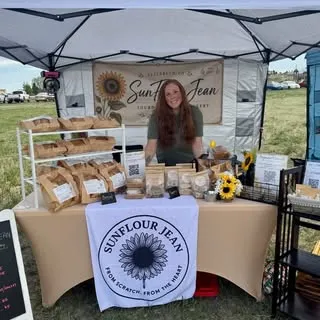
- Hannah Rabideau - 🌻SunFlour Jean🌻 | Sourdough MicrobakeryElizabeth
- Sugar Mill TreatsFort Collins
- Prairie To Peak SourdoughColorado Springs
- Symphony SweetsJohnstown
- Bella’s Little BakeryBroomfield
- kinshipbreadBoulder
- Lessons & LoavesElizabeth





This page is educational, not legal advice — we’re not lawyers, just neighbors who read Colorado’s official sources and wrote down what they say (every claim above links to its source). A major expansion of the Cottage Foods Act — refrigerated foods, a $150,000 cap, and mandatory CDPHE registration — takes effect January 1, 2027; this page describes the law in force now and flags that change as upcoming. Colorado’s official statute publisher (Lexis) blocks automated reading, so the verbatim statute text here was confirmed against a current-through-Fall-2025 full-text mirror and against the signed act itself; when something here and the law disagree, the law wins. Sales-tax registration and home-rule city licenses are separate and set locally — check yours. Always double-check the details with your own city and state before you sell. When something here and the law disagree, the law wins; if you spot that happening, tell us and we’ll fix it.